These are the ten questions from War Dossier daily challenge #5, of 27 September 2026, with the correct answer and an explanation for each. Today's challenge is a different one and it is free to play.
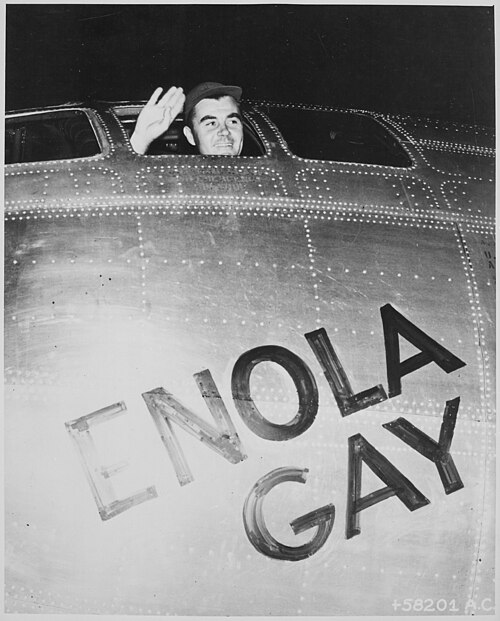
Credit: Oficina de Información de Guerra de EE. UU. (autor no especificado), NARA · Licence: Dominio público (obra del gobierno federal de EE. UU., NARA) · View at original source
The dossier entry: El Enola Gay
A B-29 Superfortress bomber (serial number 44-86292) belonging to the 509th Composite Group, piloted by Colonel Paul Tibbets, who named it after his mother. On August 6, 1945, it took off from Tinian and dropped the Little Boy bomb on Hiroshima, with Thomas Ferebee as bombardier. It is now on display at the Steven F. Udvar-Hazy Center of the National Air and Space Museum in Virginia.
Challenge answers
1 / 10
Which pilot, in command of the aircraft that dropped the first atomic bomb used in combat, appears waving in this photograph?
Paul Tibbets
Charles Sweeney
Thomas Ferebee
Robert Lewis
The photograph shows Colonel Paul Tibbets waving before takeoff toward Hiroshima.
2 / 10
What were Tinian's huge airfields, such as North Field, built for?
To operate B-29 bombers against Japan
To launch gliders
To base seaplanes
To store tanks
The runways were built so the B-29s could reach the Japanese home islands.
3 / 10
Which rugged heavy fighter did Gabreski fly in Europe?
The Republic P-47 Thunderbolt
The North American P-51 Mustang
The Lockheed P-38 Lightning
The Supermarine Spitfire
Gabreski earned his victories with the heavy, tough P-47 of the 56th Fighter Group.
4 / 10
What gesture did Hitler make toward Paulus hours before his capture, implying his suicide was expected?
He promoted him to field marshal
He awarded him the Iron Cross
He ordered him to fly to Berlin
He relieved him of command
Hitler promoted Paulus to field marshal shortly before his surrender, a gesture implying the expectation that he would take his life rather than capitulate.
5 / 10
What technical contrast defines the relationship between Würzburg and Freya?
Würzburg: short range and high precision; Freya: long range and lower precision
Würzburg: long range; Freya: short range and high precision
Both radars had exactly the same range and the same precision
Würzburg was airborne and Freya was exclusively naval
This is the classic comparison within the German air-defence network: Freya watched over long distances (up to 160 km) but with limited precision, while Würzburg, of much shorter range (up to 40 km), offered the angular and range precision needed for fire control.
6 / 10
What attitude did some commanders typically show toward the return of a pilot who had not completed his mission?
A not always favorable reception, marked by suspicion
Open celebration for every return
An immediate financial reward
An automatic promotion in rank
Returning without completing the mission sometimes generated distrust or additional pressure from some commanders, according to later survivor testimonies.
7 / 10
What social groups did the Moscow opolchenie volunteers mainly come from?
Factory workers, students, teachers and office employees
Exclusively retired officers of the tsarist army
Only members of the Soviet Politburo
Only prisoners released from the gulags
Volunteers mostly came from factories, universities and offices, many exempt by age or profession from regular service.
8 / 10
What makes the Browning M2 (.50 cal) machine gun especially notable in terms of service longevity?
It remains in active service today, nearly 100 years after its adoption
It was withdrawn from service as soon as the war ended
It was only used for 5 years total
It was never exported outside the US
The Browning M2 remains in active service in dozens of armies worldwide, nearly a century after its 1933 adoption — an extraordinarily long operational life for any weapon design.
9 / 10
Although they fought as part of the British Indian Army, under which sovereignty did the Gurkha soldiers' kingdom of origin formally remain?
An independent kingdom, with its own agreements with Britain
A directly administered British colony
A territory under Japanese mandate
Just another province of British India
Nepal was an independent kingdom that maintained friendship and recruitment agreements with Britain, without being a colony or an Indian province.
10 / 10
What nickname did Japanese pilots give the P-38 Lightning because of its unusual twin-fuselage silhouette?
"Two planes, one pilot"
"The silver dragon"
"The night ghost"
"The twin hawk"
Japanese pilots nicknamed the P-38 'two planes, one pilot' because of its unmistakable twin-boom design. German pilots, meanwhile, called it 'der Gabelschwanz-Teufel' ('the fork-tailed devil').
Today's challenge is another ten questions. No sign-up, nothing to install.