WW2 trivia · daily challenge archive

War Dossier › Archive › Challenge #4

Leer este reto en español

Challenge #4

These are the ten questions from War Dossier daily challenge #4, of 26 September 2026, with the correct answer and an explanation for each. Today's challenge is a different one and it is free to play.
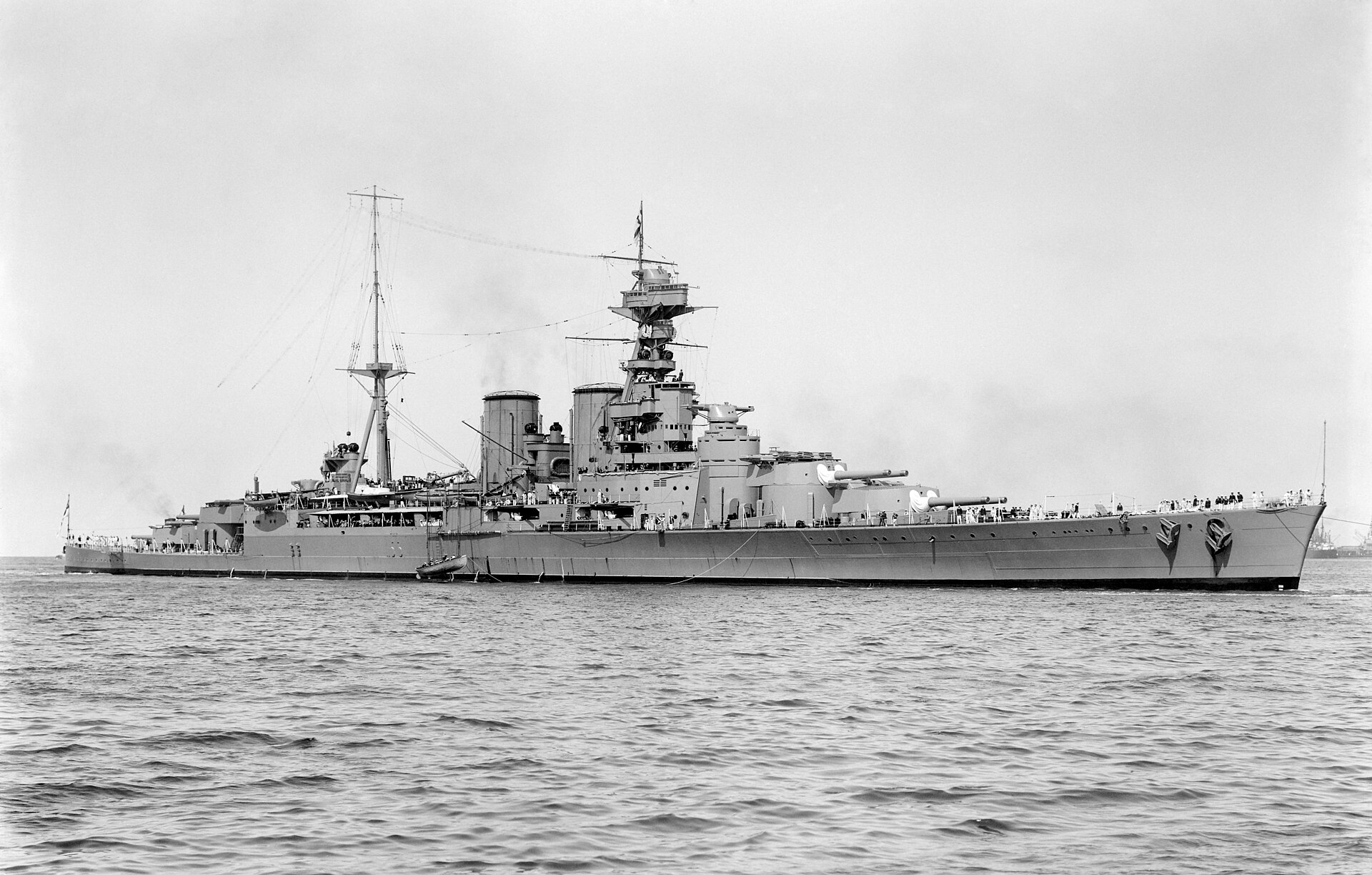
Which British warship, sunk in May 1941, is shown in this photograph taken years earlier?
Credit: Allan C. Green, restauracion de Adam Cuerden, State Library of Victoria · Licence: Dominio publico, copyright expirado · View at original source

The dossier entry: El hundimiento del HMS Hood

On 24 May 1941, in the Battle of the Denmark Strait, the British battlecruiser HMS Hood engaged the battleship Bismarck and the heavy cruiser Prinz Eugen. Struck in one of her magazines, she exploded and sank within a few minutes, with the loss of almost her entire crew.

Challenge answers

1 / 10

Which British warship, sunk in May 1941, is shown in this photograph taken years earlier?

  • HMS Hood
  • HMS Rodney
  • HMS Prince of Wales
  • HMS Ark Royal

This is HMS Hood, photographed years before her loss in the Denmark Strait.

2 / 10

What wooded massif did the armored divisions cross before forcing the Meuse?

  • The Ardennes
  • The Vosges
  • The Black Forest
  • The Landes

The armored divisions crossed the Ardennes, terrain the Allied command considered ill-suited for armor.

3 / 10

On what date did the Bukit Timah position fall into Japanese hands?

  • 11 February 1942
  • 15 February 1942
  • 8 December 1941
  • 1 March 1942

The Japanese took Bukit Timah in the early hours of 11 February 1942, four days before the garrison's final surrender.

4 / 10

Unlike Operation Ring, which liquidated the Stalingrad pocket in January 1943, what was Operation Winter Storm of December 1942 aiming to do?

  • Break the Soviet encirclement from outside to relieve the 6th Army
  • Force the immediate surrender of the 6th Army from within the pocket
  • Capture the Pitomnik and Gumrak airfields for the Soviet side
  • Evacuate Stalingrad's civilian population before the final assault

While Operation Ring (January 1943) was the Soviet offensive to eliminate the pocket, Winter Storm (December 1942) was the German attempt, from outside, to break the encirclement.

5 / 10

What level of secrecy was given to the development of the VT proximity fuze during the war?

  • It was guarded with secrecy comparable to the atomic bomb project
  • It was openly published in civilian technical journals
  • It was immediately shared with Japanese forces
  • It was not considered necessary to keep it secret

Due to its great tactical value, the VT fuze was kept under a level of secrecy comparable to other major wartime projects.

6 / 10

Which country suffered the greatest absolute human losses in Europe during the war?

  • The Soviet Union
  • France
  • The United Kingdom
  • Italy

The Soviet Union recorded the highest absolute human losses of any country in the conflict in Europe.

7 / 10

What happened to a large part of the Soviet troops trapped in the forest near the villages inside the Uman pocket?

  • They began surrendering after breakout attempts failed
  • They were rescued by a successful Soviet counteroffensive
  • They crossed the front without losses through an opened corridor
  • They kept fighting in an organized way until winter

After breakout attempts failed, the soldiers trapped in the nearby forests began surrendering en masse in early August.

8 / 10

About how much did the V-2's explosive warhead weigh?

  • About 1,000 kg of amatol
  • About 100 kg of TNT
  • About 5,000 kg of amatol
  • About 300 kg of Trialen 105

The V-2's warhead carried around 1,000 kg of amatol, delivered with no advance warning sound since the rocket travelled faster than sound for most of its trajectory.

9 / 10

What aiming disadvantage did the PIAT's projectile have compared to rocket weapons like the Bazooka?

  • It flew much slower with a curved trajectory, making long-range aiming harder
  • It could only be fired in a perfectly straight line, with no angle at all
  • It became completely invisible once fired
  • It only worked at night

Being spring-propelled rather than rocket-propelled, the PIAT's bomb flew much slower with a more curved ('lobbed') trajectory, making medium-to-long-range aiming noticeably harder than with a rocket weapon.

10 / 10

Into which two groups did the Purple machine split the 26-letter alphabet for encryption?

  • A group of 6 letters and a group of 20 letters, enciphered separately
  • Vowels and consonants, enciphered using two different tables
  • Two groups of 13 letters each, enciphered using the same table
  • Uppercase and lowercase letters, handled with different mechanisms

Inherited from the earlier Red machine, this design enciphered the 6-letter subgroup with a simpler mechanism than the 20-letter subgroup — a structural weakness that American cryptanalysts were able to exploit.

Today's challenge is another ten questions. No sign-up, nothing to install.

Play today's challenge