These are the ten questions from War Dossier daily challenge #21, of 13 October 2026, with the correct answer and an explanation for each. Today's challenge is a different one and it is free to play.
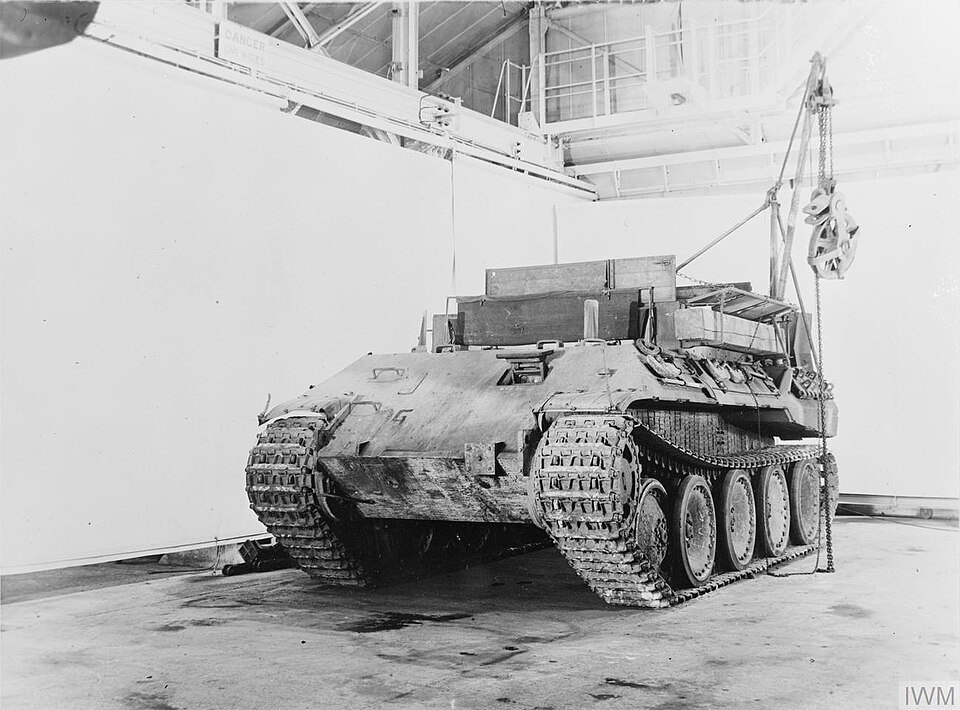
Credit: Imperial War Museums, fotografo no identificado · Licence: Dominio publico (foto oficial britanica anterior a 1957) · View at original source
The dossier entry: El Bergepanther
The Bergepanther was built on the turretless Panther chassis and fitted with a winch and a folding jib to lift heavy components such as engines or damaged turrets. It served in the maintenance companies of Panzer divisions to tow and recover damaged or disabled tanks from the battlefield, a role in which it is considered one of the most effective recovery vehicles of the war.
Challenge answers
1 / 10
What type of vehicle is shown in the photograph, turretless and set up to lift heavy loads?
a Bergepanther recovery vehicle
an Elefant tank destroyer
a Panzerbefehlswagen command tank
a flame-thrower tank
The lack of a turret and the folding jib at the rear are typical of the recovery vehicle based on the Panther.
2 / 10
Besides those who served in uniform, in what other way did many celebrities take part in the war effort without enlisting?
Taking part in tours and fundraising campaigns
Running weapons factories
Sitting on military tribunals
Piloting reconnaissance planes
Many celebrities, without enlisting, took part in entertainment tours and fundraising campaigns.
3 / 10
Which trait best describes the different groups that were part of the German resistance against Hitler?
Came from diverse backgrounds: military, conservative, religious, labour and student
They were made up solely of high-ranking Army officers
They acted under the direct control of foreign governments
They were limited to printed propaganda with no organised action
Internal opposition to Hitler brought together very diverse sectors, from military officers and conservative aristocrats to social democrats, communists, churches and university students.
4 / 10
When did Turkey become a founding member of the United Nations, after signing the Charter in San Francisco?
October 1945
February 1945
January 1946
July 1944
Turkey signed the UN Charter and was among the original members in October 1945.
5 / 10
What kind of facilities were targets of documented attacks by Japanese troops after the fall of Hong Kong?
Improvised medical facilities
Port facilities
Radio stations
Fuel depots
Attacks against field hospitals and medical staff were documented in the final days of the battle.
6 / 10
What mocking nickname, comparing it to a German tank destroyer, did the SU-76 get from its own crews?
The bare-arsed Ferdinand
The little Tiger
The red Panther
The pocket Elephant
Because of its open compartment and silhouette, crews nicknamed the SU-76 'the bare-arsed Ferdinand,' mocking the heavy German tank destroyer.
7 / 10
How many days in total passed between the landing and the island being declared secure?
Seventy-three days
Four days
Thirty-six days
A hundred and twenty days
From 15 September to 27 November 1944, seventy-three days of uninterrupted fighting elapsed.
8 / 10
Compared with the Ordnance QF 6-pounder in this same list, what mainly distinguishes the ML 3-inch mortar?
It is far lighter and man-portable, with no carriage or gun shield
It has a longer range than the 6-pounder
Both fire armour-piercing rounds against armour
The mortar weighs over a tonne, the same as the 6-pounder
The 3-inch mortar weighs just over 50 kg and is carried by the infantry itself in three parts, while the 6-pounder weighs over a tonne (1,145 kg) and needs to be towed; their roles also differ, since the mortar lobs support bombs at short range while the 6-pounder fires armour-piercing rounds at tanks.
9 / 10
What fighter aircraft did the FAB's 1st Fighter Group (the Jambock) fly on the Italian front?
The Republic P-47 Thunderbolt
The Supermarine Spitfire
The Messerschmitt Bf 109
The P-40 Warhawk, until the end of the war
In combat over Italy, the unit flew the P-47 Thunderbolt, having trained earlier on the P-40.
10 / 10
Which section of the Ledo Road was known as 'Hell Pass'?
Pangsau Pass, with hairpin curves and drops of up to 60 metres
The final stretch before reaching Kunming
The bridge over the Brahmaputra river
The border crossing with Thailand
Pangsau Pass, on the India-Burma border, was so treacherous with its hairpin bends and sheer drops that soldiers nicknamed it 'Hell Pass.'
Today's challenge is another ten questions. No sign-up, nothing to install.