These are the ten questions from War Dossier daily challenge #22, of 14 October 2026, with the correct answer and an explanation for each. Today's challenge is a different one and it is free to play.
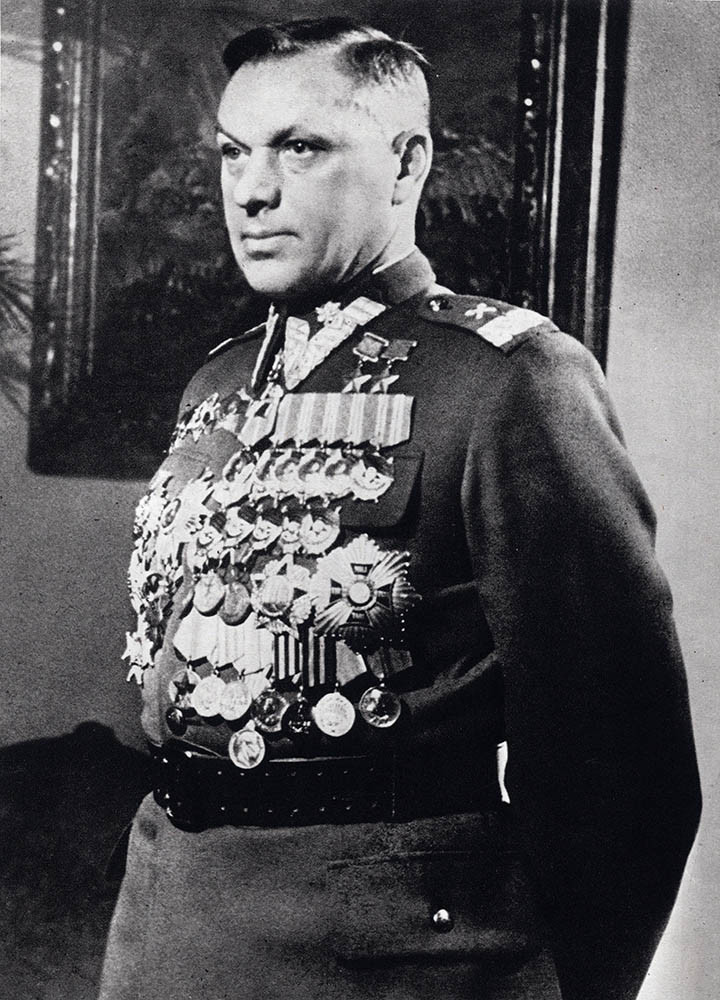
Credit: Autor desconocido - Museo del Cobre (muzeum-miedzi.art.pl) · Licence: Dominio publico (PD-Polonia) · View at original source
The dossier entry: Rokossovski y el plan del doble golpe
As commander of 1st Belorussian Front, Konstantin Rokossovsky proposed two simultaneous main thrusts north and south of the Pripyat marshes toward Bobruisk, instead of concentrating the attack on a single axis. When Stalin questioned the plan during a Stavka meeting, Rokossovsky asked to leave the room to reconsider it and returned twice with the same recommendation, which was ultimately approved and validated by the operation's success. Years later he would also hold the rank of Marshal of Poland.
Challenge answers
1 / 10
Which Soviet marshal is shown in this portrait, wearing the uniform of a Marshal of Poland?
Konstantin Rokossovsky
Georgy Zhukov
Ivan Konev
Semyon Timoshenko
The portrait shows Konstantin Rokossovsky, who years after Bagration became Marshal of Poland.
2 / 10
What caliber was the Ordnance QF 17-pounder?
76.2 mm
57 mm
88 mm
94 mm
Its caliber was 76.2 mm (3 inches). Despite being named '17-pounder' after its shell weight, that caliber put it in the same league as the feared German 88 mm in terms of anti-tank lethality.
3 / 10
In which month of the Luzon campaign did the rescue of the Cabanatuan prisoners take place?
January 1945
October 1944
March 1945
September 1945
The rescue took place on the night of 30 January 1945, just weeks after the Lingayen Gulf landing.
4 / 10
Which larger unit did the so-called 'X-Troop' belong to?
No. 10 (Inter-Allied) Commando
The 1st Parachute Brigade
The Special Boat Section
The French Foreign Legion
X-Troop was No. 3 Troop of No. 10 (Inter-Allied) Commando.
5 / 10
Comparing the Japanese I-400 submarine with the American Gato-class submarine (USS Gato) in this collection, which had the greater displacement?
The I-400, at 6,560 t versus the Gato's 1,525 t
The Gato, at 6,560 t versus the I-400's 1,525 t
Both had practically the same displacement
The Gato was actually larger since it was built later
The I-400 displaced 6,560 tonnes compared to the American Gato-class submarine's 1,525 tonnes, more than four times as much, making it the largest submarine built up to that time, large enough to house a full floatplane hangar.
6 / 10
Ernst Barkmann's action in July 1944 took place during...
the Allied breakout on the Normandy front known as Operation Cobra
the initial fighting of D-Day, on 6 June
the German retreat after the fall of the Falaise pocket
the Allied advance toward the Rhine, already in 1945
Barkmann's action took place during Operation Cobra, the Normandy front breakout launched by American forces in late July 1944.
7 / 10
When did construction of Guam's North Field begin?
November 1944
June 1942
August 1945
March 1943
Work began in November 1944, after the island's liberation.
8 / 10
In which part of the United States were many of the Axis prisoner camps concentrated?
In rural areas of the south and southwest of the country
In the major industrial cities of the northeast
In naval bases on the Pacific coast
In Alaska and the Arctic territories
Sites were chosen away from industrial areas, with mild climates, mostly in the south and southwest of the country.
9 / 10
In what year were the blueprints for the standard A4 variant of the Browning M1919 finalized?
1936
1919
1942
1928
The M1919 family debuted in 1919, but the standard World War II A4 variant (the most widespread) had its blueprints finalised in late 1936. It was also used, in various forms, mounted in tanks and aircraft.
10 / 10
Which of these events of the 1939 Polish campaign was the overall offensive of which the others were specific episodes?
The German invasion of Poland as a whole
The attack on the Westerplatte depot
The dawn bombing of Wieluń
The Battle of the Bzura river
Westerplatte, Wieluń and the Battle of the Bzura were specific episodes within the general offensive Germany unleashed on 1 September 1939.
Today's challenge is another ten questions. No sign-up, nothing to install.