These are the ten questions from War Dossier daily challenge #13, of 5 October 2026, with the correct answer and an explanation for each. Today's challenge is a different one and it is free to play.
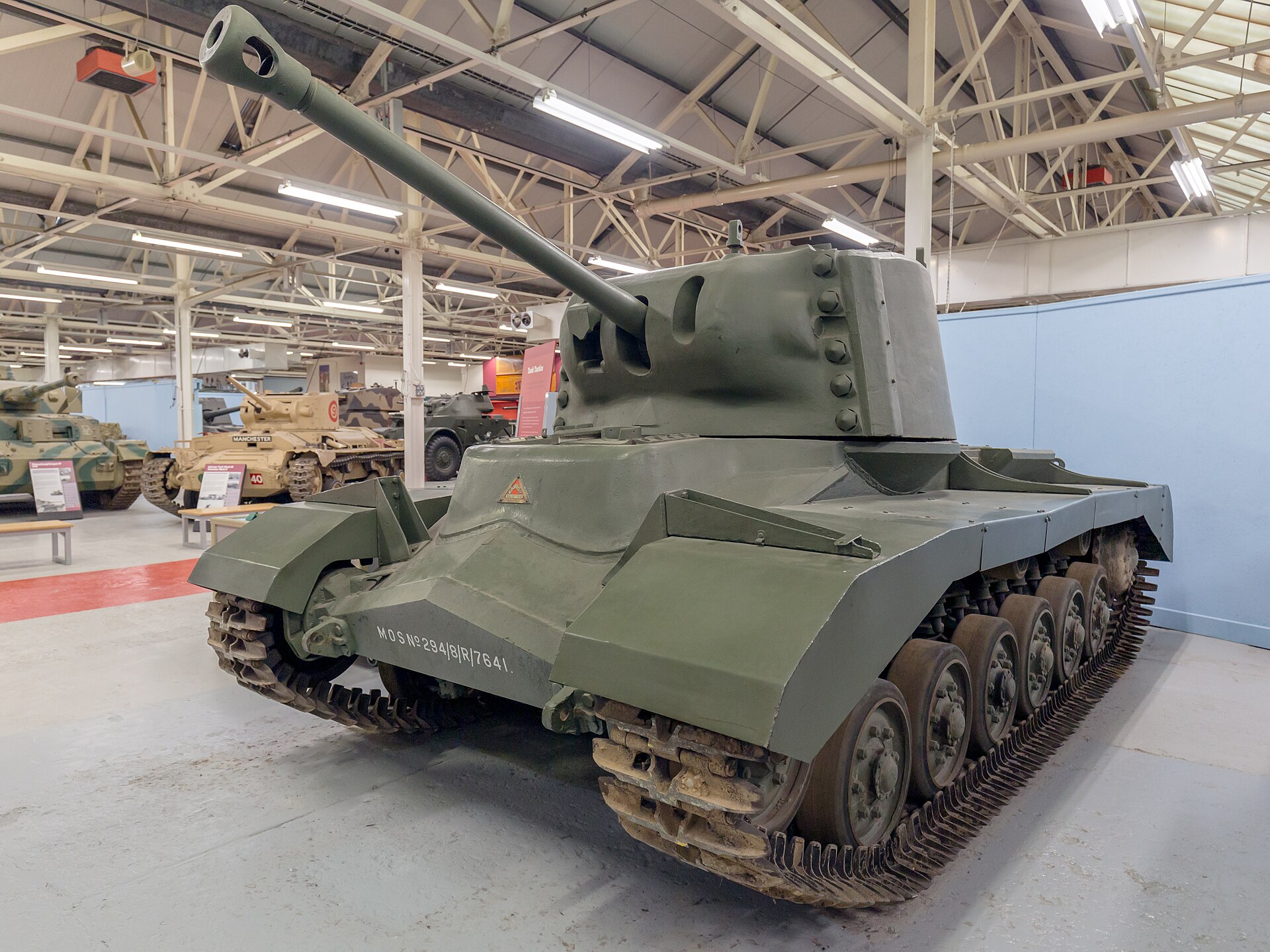
The A38 Valiant was a roughly 27-tonne British infantry support tank, designed by Vickers in 1943 to fight Japan in South-East Asia with up to 114mm of armor on minimal weight. The result was a vehicle with serious problems: during 1945 trials at Chertsey, testing was abandoned after just 13 miles due to the risk of injury and driver exhaustion. Only one prototype was built, later kept as an example of failed design at the School of Tank Technology and now preserved at the Bovington museum.
Challenge answers
1 / 10
Identify this British infantry support tank, considered one of the worst of the war due to its design flaws.
A38 Valiant
A39 Tortoise
TOG 2
T14
This is the A38 Valiant, whose serious design flaws made it a case study in poor engineering practice.
2 / 10
Which general commanded, from its formation in August 1944, the 1st French Army that arose from the forces landed in Provence?
Jean de Lattre de Tassigny
Philippe Leclerc
Alphonse Juin
Marie-Pierre Kœnig
Jean de Lattre de Tassigny commanded this army from its formation in August 1944.
3 / 10
How did the Allied soldiers react to the term used to describe them in enemy propaganda?
They proudly adopted it as their own badge of identity
They filed a formal complaint with high command
They ignored it completely throughout the siege
They asked for the name to be withdrawn from their units
The soldiers proudly adopted the term, turning it into the garrison's badge of identity.
4 / 10
Unlike the final convoys of 1945, which crossed the route almost without losses, what characterized the PQ-17 convoy disaster in 1942?
Catastrophic losses after the convoy's scattering
The total absence of enemy attacks
The exclusive participation of Soviet ships
Permanent icebreaker escort
Unlike the final convoys of 1945, PQ-17 suffered catastrophic losses after the order to scatter.
5 / 10
What kind of stock did the Sten Mk II have, contributing to its extremely simple construction?
A skeletal wire stock
A solid rifle-type wooden stock
A folding bakelite stock
It had no stock of any kind
The Sten Mk II used a skeletal wire stock, in keeping with its extremely simple stamped-metal-tube design philosophy, intended to be manufactured cheaply and quickly after the material losses at Dunkirk.
6 / 10
In what year was Carl Goerdeler executed, after several weeks on the run from the Gestapo?
1945
1944
1943
1946
Goerdeler was captured after weeks on the run and executed in February 1945.
7 / 10
What kind of rock were most of Malta's underground shelters and tunnels carved into?
Limestone
Granite
Volcanic basalt
Red sandstone
Malta is composed mainly of limestone, a relatively soft and easily excavated material, which allowed the population and garrison to carve out numerous shelters during the siege.
8 / 10
Which aircraft is shown in the photograph?
Douglas C-47 Skytrain / Dakota
Boeing B-17
Heinkel He 111
B-24 Liberator
You can spot it by its tubular fuselage with no visible weapons and the large rear left side cargo door, quite different from bombers with defensive turrets. It dropped thousands of paratroopers the night before D-Day.
9 / 10
When was XXI Bomber Command activated?
1 March 1944
18 July 1944
7 December 1941
2 September 1945
It was activated on 1 March 1944 for the strategic offensive against Japan.
10 / 10
Who commanded the division during the assault on Betio?
Major General Julian C. Smith
Lieutenant General Holland Smith
Admiral Raymond Spruance
Major General Ralph Smith
Julian C. Smith led the 2nd Marine Division at Tarawa; Holland Smith commanded the amphibious corps.
Today's challenge is another ten questions. No sign-up, nothing to install.