These are the ten questions from War Dossier daily challenge #11, of 3 October 2026, with the correct answer and an explanation for each. Today's challenge is a different one and it is free to play.
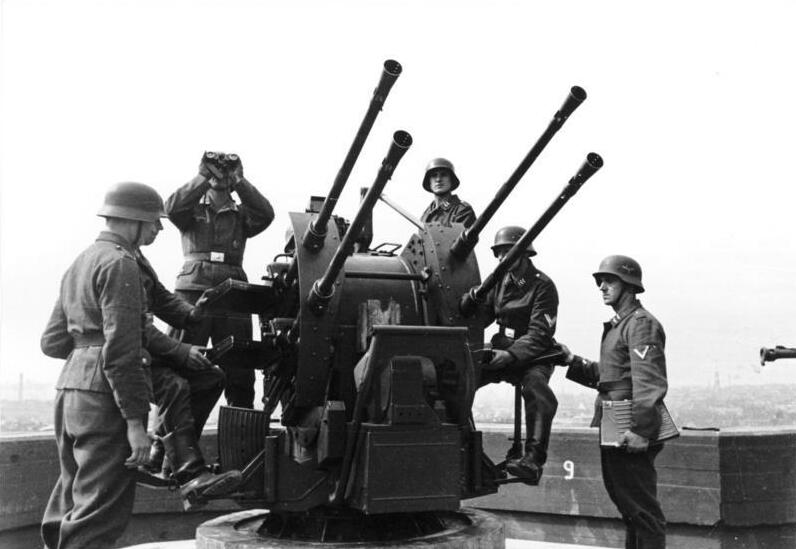
Credit: Walther (Bundesarchiv Bild 101I-635-4000-24) · Licence: CC BY-SA 3.0 DE · View at original source
Challenge answers
1 / 10
Which German anti-aircraft gun is shown in the photograph?
2 cm Flakvierling 38
3.7 cm Flak 36/37
8.8 cm Pak 43
7.5 cm Pak 40
It is instantly recognisable by its four 20mm barrels grouped on a single circular mount, firing together to create a dense anti-aircraft curtain of fire.
2 / 10
What did Red Army armor tactics rely on most in the second half of the war?
Attacking en masse in successive waves to swamp the defenses
Individual long-range duels, like the Germans
Avoiding combat and harassing only at night
Always operating tanks alone, without infantry
The Red Army leaned on its numbers, attacking en masse in echeloned waves, with infantry (often riding the tanks) to swamp and break the German defenses.
3 / 10
Who directed the film "The Bridge on the River Kwai" (1957)?
David Lean
John Sturges
Steven Spielberg
William Wyler
David Lean directed the film, based on Pierre Boulle's novel, which won seven Academy Awards.
4 / 10
How many crew did the T-70 have?
2
3
4
1
With just 2 crew members (driver and commander), the T-70's commander also had to aim and load the gun himself, a task overload that greatly limited its combat effectiveness.
5 / 10
In what year did the Type 13 radar enter service?
1943
1938
1941
1944
The Type 13 entered service in August 1943, answering Japan's urgent need for radar warning against growing Allied air attacks.
6 / 10
What was the main reason the Japanese advance stopped at this point instead of continuing toward Port Moresby?
The collapse of the supply line along the track
A massive Australian counterattack with armor
An Allied naval bombardment of the coast
The formal surrender of Japanese high command in the area
The main factor was the logistical collapse —shortage of carriers and food along the track— compounded by Australian resistance, forcing the halt and withdrawal.
7 / 10
What symptoms did Audie Murphy carry for years after returning from the war?
Nightmares and insomnia
Short-term memory loss
Partial paralysis of one arm
Loss of night vision
Murphy suffered for years from nightmares and insomnia, symptoms associated with what is now called post-traumatic stress.
8 / 10
Compared with the M24 Chaffee that would succeed it in light reconnaissance, what mainly limited the M3 Stuart in combat against enemy tanks?
Its 37 mm gun, not very effective against medium armor
Its lack of a radio
Its excessive weight, greater than any medium tank
Its unreliable diesel engine in cold climates
The M24 Chaffee mounted a 75 mm gun that clearly surpassed the anti-armor capability of the M3 Stuart's 37 mm gun.
9 / 10
Roughly how many months did MacArthur's command from Corregidor last before his departure?
A little under three months
A little over a year
About two weeks
Exactly six months
Between 24 December 1941 and 11 March 1942, a little under three months passed.
10 / 10
What did the German defense of Carentan and that of Cherbourg weeks later have in common?
Both were defended by German forces before yielding to American forces
Both towns had the region's only deep-water port
Both were captured by the British 6th Airborne
The same Resistance sabotage plans were activated in both
Both the German paratroopers at Carentan and von Schlieben's garrison at Cherbourg resisted fiercely before being defeated by the American advance.
Today's challenge is another ten questions. No sign-up, nothing to install.