These are the ten questions from War Dossier daily challenge #1, of 23 September 2026, with the correct answer and an explanation for each. Today's challenge is a different one and it is free to play.
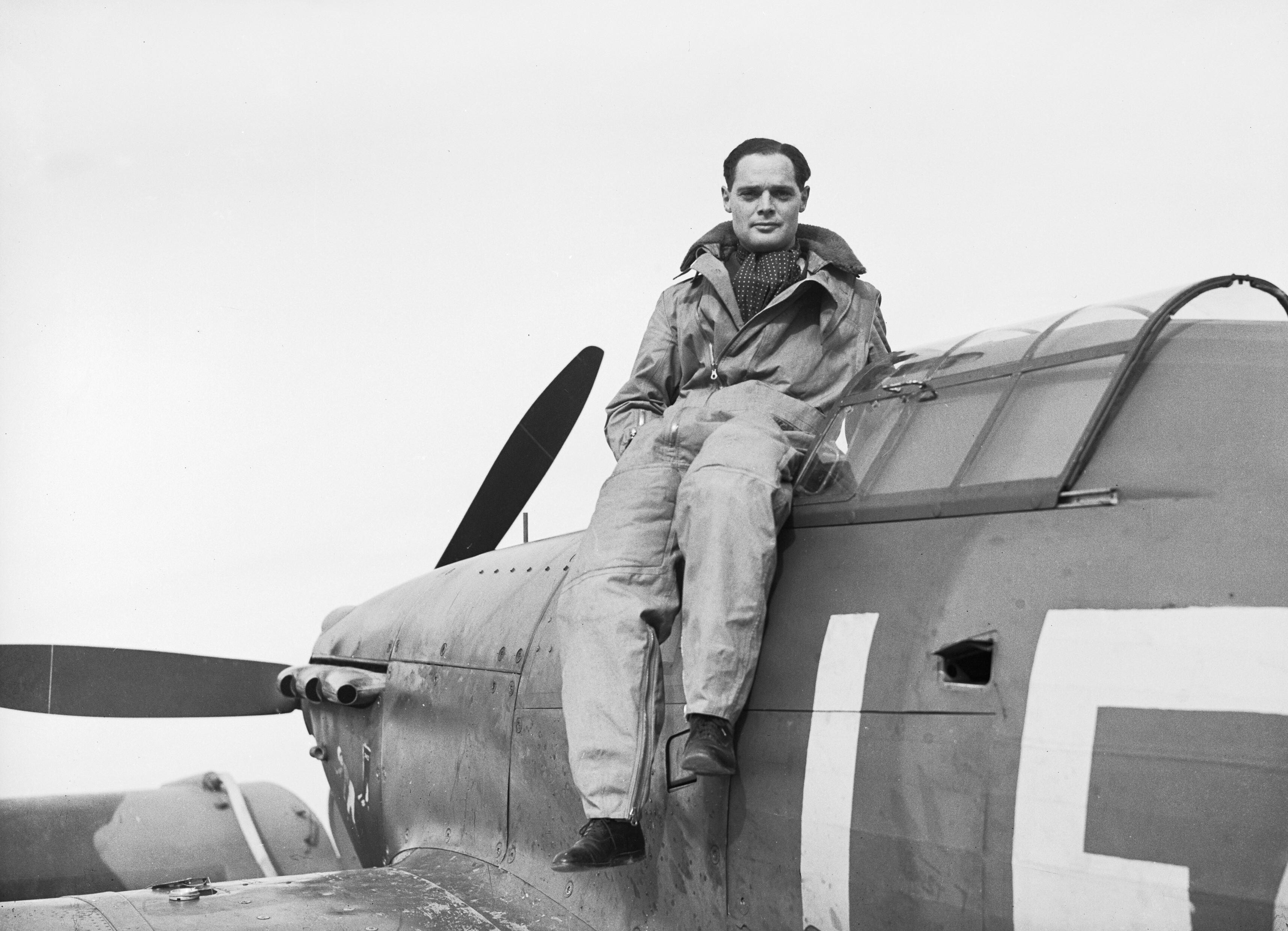
Credit: Stanley Devon, Royal Air Force official photographer · Licence: Dominio publico (fotografia anterior a 1957, Crown Copyright, IWM)
Challenge answers
1 / 10
The photograph shows a pilot seated in his Hawker Hurricane at Duxford in September 1940. Who is he, an ace known for fighting despite having lost both legs?
Douglas Bader
Adolph 'Sailor' Malan
Robert Stanford Tuck
James "Johnnie" Johnson
Douglas Bader, who had lost both legs in a flying accident years before the war, commanded No. 242 Squadron and became one of the most recognizable faces of Fighter Command during the battle.
2 / 10
In which city did the July 1944 parade of German prisoners of war take place, after which the streets they had marched through were symbolically washed?
Moscow
Minsk
Warsaw
Berlin
The episode took place in central Moscow, after the column of prisoners passed on 17 July 1944.
3 / 10
Which British general created the Chindits' long-range penetration concept?
Orde Wingate
William Slim
Claire Chennault
Joseph Stilwell
General Orde Wingate conceived and led the Chindits.
4 / 10
Unlike infantry field trenches, a position like the Todt Battery represents...
A permanent concrete fortification, built over years by specialist engineers
An improvised work that infantry could dig in a few hours
A passive obstacle with no weapons of any kind
A purely naval structure, with no land-based guns
The Todt Battery took a year and a half to build, with several metres of reinforced concrete and large-calibre naval guns; a field trench, by contrast, was dug by the infantry themselves in hours or a few days with hand tools, with nothing permanent about it.
5 / 10
How did the two squadrons fight on 8 May, some 210 nautical miles apart?
Entirely with carrier aircraft, over the horizon
With gun duels between battleships
With massed submarine attacks
With torpedo boats launched from the coast
The fleets attacked only with their carrier aircraft, without ever seeing each other, over 200 miles apart.
6 / 10
How did Berling's army's attempt to link up with the insurgents end after several days of isolated fighting?
Survivors had to withdraw to the opposite bank with very heavy losses
They consolidated a permanent bridgehead until the capitulation
They were evacuated without fighting, having met no German resistance
They joined the insurgent forces in the city permanently
Facing insufficient support and German pressure, survivors had to withdraw to the eastern bank of the Vistula with very heavy losses.
7 / 10
How much and what type of explosive did the Type 99 mine carry, and how was it triggered?
680 g of TNT/RDX, with an external delay fuse of 5-10 seconds
5 kg of dynamite, detonated by remote wire control
50 g of black powder with a visible fuse
680 g of liquid nitroglycerin with no fuse
The Type 99 packed 680 grams of TNT/RDX explosive into a disc just 12 cm in diameter and 4 cm tall, with an external fuse giving the soldier 5 to 10 seconds to get clear after placing it on the target. Its four magnets, mounted in a hemp-cloth casing, allowed it to be quickly fixed to metal surfaces.
8 / 10
What weakness did the Marder tank destroyers share in the face of enemy fire, in exchange for their improved firepower?
An open superstructure with light armor, very vulnerable
An underpowered engine that made them slower than a heavy tank
The total absence of a main gun
Excessive weight that prevented crossing bridges
In exchange for more firepower, the Marder had an open superstructure and light armor, very vulnerable.
9 / 10
What direct connection exists between "The Great Escape" and the winter 1944-45 marches?
Both relate to Stalag Luft III, the site of the 1944 escape and of a forced evacuation in 1945
Both took place in Australia
Both relate to Colditz (Oflag IV-C), another camp famous for its escapes
Both concerned Axis prisoners in the United States
Stalag Luft III was the site of the real March 1944 escape recreated in the film, and it was also evacuated on foot in January 1945.
10 / 10
Which neutral country did the Allies try to bring in during a brief second phase of the Cairo Conference, in December 1943?
Turkey
Spain
Sweden
Portugal
After Tehran, Roosevelt and Churchill met again briefly in Cairo with Turkish president Ismet Inonu, without securing Turkey's entry into the war.
Today's challenge is another ten questions. No sign-up, nothing to install.