WW2 trivia · daily challenge archive

War Dossier › Archive › Challenge #42

Leer este reto en español

Challenge #42

These are the ten questions from War Dossier daily challenge #42, of 3 November 2026, with the correct answer and an explanation for each. Today's challenge is a different one and it is free to play.
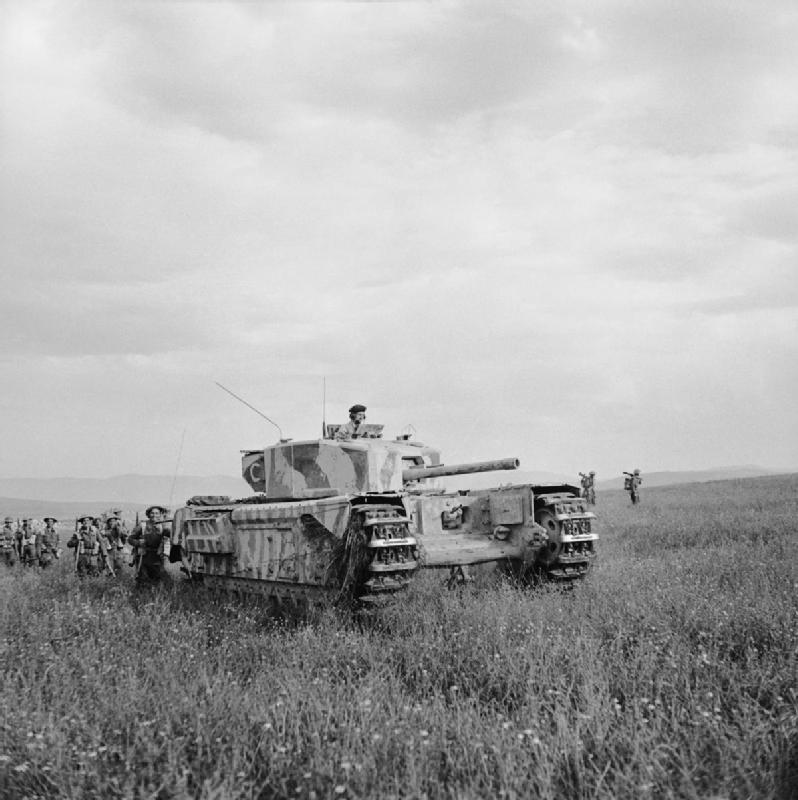
What heavy British tank advances alongside infantry in this photograph taken in Tunisia in 1943?
Credit: Sgt Silverside, No 2 Army Film and Photographic Unit (IWM NA 2578) · Licence: PD-UKGov (Crown Copyright expirado) · View at original source

The dossier entry: Las variantes de combate del Churchill (Mk III-VII)

Starting with the Mk III variant, with a welded turret and a 6-pounder gun, the Churchill showed in Tunisia during 1942-43 an exceptional ability to absorb hits thanks to its thick armour. The Mk IV and Mk VI versions kept or improved that armament, while the Mk VII, the "heavy Churchill", raised frontal armour to 152 mm, thicker than a Tiger I's front, and reached Normandy in 1944 with a 75 mm gun. Across its combat variants, the Churchill prioritised protection and obstacle-crossing ability over speed.

Challenge answers

1 / 10

What heavy British tank advances alongside infantry in this photograph taken in Tunisia in 1943?

  • The Churchill
  • The Matilda II
  • The Valentine
  • The Cromwell

It is a Churchill advancing with infantry near Medjez-el-Bab, Tunisia, in May 1943.

2 / 10

How has the Alexandra Hospital incident been assessed in later historical accounts of the campaign?

  • It is regarded as one of the gravest acts committed by Japanese troops in the campaign
  • It is described as a minor incident with barely any impact
  • It was attributed entirely to Commonwealth troops
  • It was officially denied by every source after the war

The episode is cited in the historiography of the campaign as one of the gravest acts committed by Japanese troops in Singapore.

3 / 10

Which two American divisions defended Elsenborn Ridge against the 6th SS Panzer Army?

  • 2nd and 99th Infantry
  • 1st and 9th Armored
  • 101st and 82nd Airborne
  • 4th and 10th Armored

The veteran 2nd Infantry and the inexperienced 99th withdrew in order and held the ridge together.

4 / 10

What factor forced the Allies to evacuate Norway in June 1940?

  • The German offensive in France and lack of air cover
  • A mutiny among Polish troops
  • The USSR entering the war
  • A typhus epidemic

The lack of air cover and the need to reinforce France against the German offensive led to the Allied withdrawal.

5 / 10

In what year did the American Volunteer Group first become operational in China?

  • 1941
  • 1937
  • 1943
  • 1945

The AVG entered combat in December 1941, before the US officially entered the war.

6 / 10

Unlike the German Volkssturm, which sent civilians into combat, what did the American USO do?

  • To entertain and lift the soldiers' spirits
  • To manufacture weapons
  • To relocate the civilian population
  • To ration clothing

The Volkssturm pushed civilians into fighting, whereas the USO used performers to sustain the troops' spirits.

7 / 10

In what earlier arm of service had General Jonathan Wainwright built his career before taking command in the Philippines?

  • The cavalry
  • Naval aviation
  • Submarines
  • The signal corps

Wainwright came from the US cavalry before taking senior commands in the Philippines.

8 / 10

How many launch tubes did the Nebelwerfer 41 have?

  • 6
  • 16
  • 4
  • 1

It had 6 launch tubes grouped in a single rotating frame, fired in a fixed sequence over about 10 seconds for the entire salvo.

9 / 10

Unlike the final German collapse of 1945, what characterized the German advance in Barbarossa's first weeks?

  • Advances of dozens of kilometres per day and large encirclements of Soviet troops
  • A constant retreat in the face of Soviet resistance
  • A total absence of fighting in the first months
  • The exclusive use of chemical weapons

In the first weeks, German armoured groups advanced rapidly, encircling hundreds of thousands of Soviet soldiers at Bialystok-Minsk and Smolensk.

10 / 10

During which air offensive against German industry did Stewart act as second-in-command of a bombing formation?

  • The 'Big Week' strategic bombing offensive
  • Operation Market Garden
  • Operation Overlord on the beaches
  • Operation Dragoon in southern France

Stewart acted as second-in-command of a 2nd Bombardment Wing formation during 'Big Week', against the German aircraft industry.

Today's challenge is another ten questions. No sign-up, nothing to install.

Play today's challenge