1 / 10
Which vehicle appears in the photograph?
- The SU-76
- The SU-122
- The SU-100
- The ZSU-37
The image shows an SU-76, with its open-topped fighting compartment, supporting infantry near Königsberg.
War Dossier › Archive › Challenge #31
These are the ten questions from War Dossier daily challenge #31, of 23 October 2026, with the correct answer and an explanation for each. Today's challenge is a different one and it is free to play.
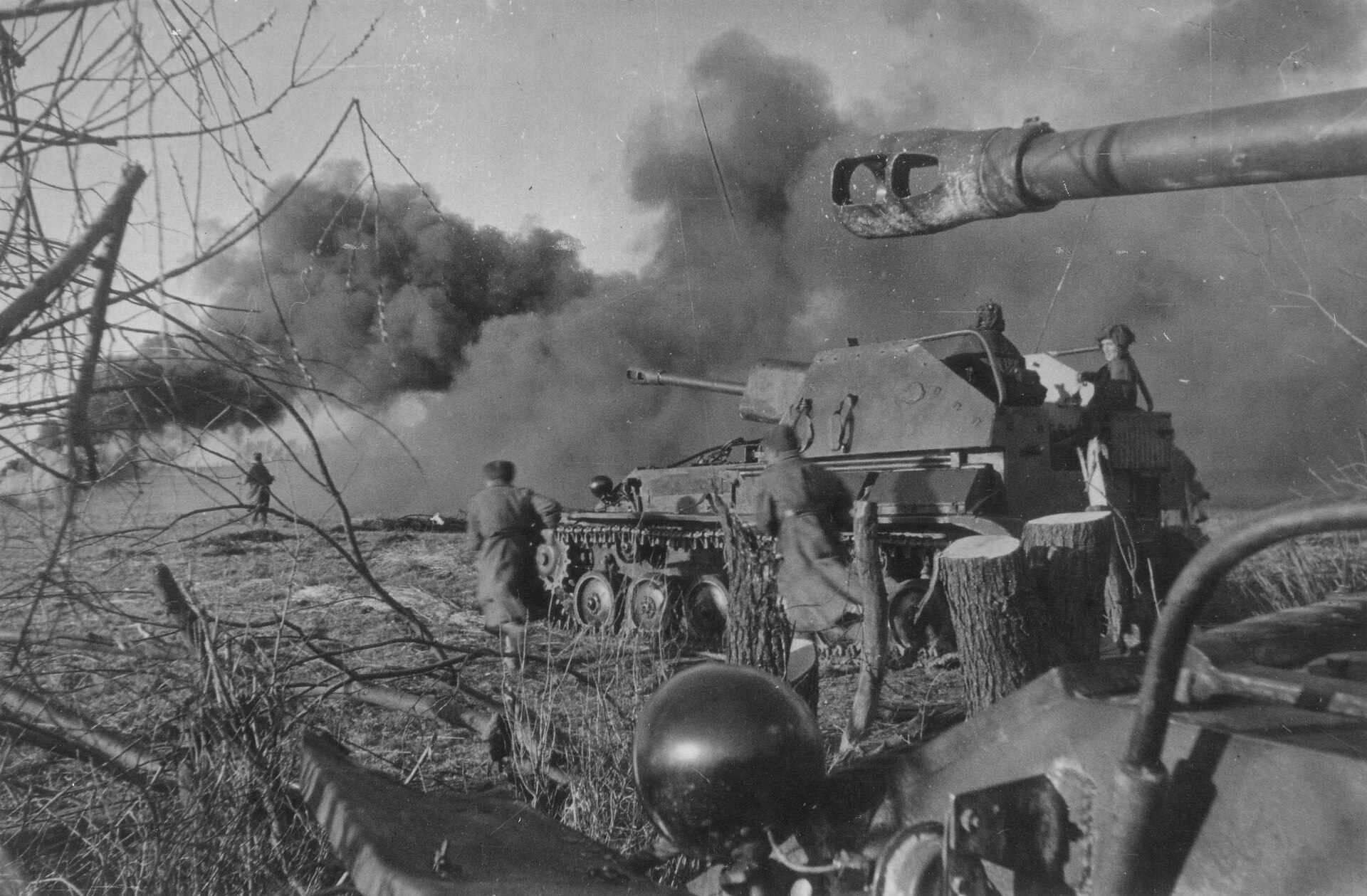
The SU-76 was by far the most-produced Soviet armored vehicle after the T-34 itself: more than 14,000 were built between 1942 and 1945. Its light armor and open-topped fighting compartment earned it unflattering nicknames among its crews, such as 'suka' ('bitch') or 'the bare-arsed Ferdinand,' mockingly compared to the heavy German Ferdinand tank destroyer. Despite its poor initial reputation, its 76 mm gun and ability to keep up with the infantry over rough terrain made it an ever-present fire support vehicle in the Red Army until the war's end.
1 / 10
The image shows an SU-76, with its open-topped fighting compartment, supporting infantry near Königsberg.
2 / 10
Tirpitz was commissioned on 25 February 1941.
3 / 10
Colonel Paul Tibbets commanded this unit, activated in December 1944.
4 / 10
Much of German supply transport depended on trucks rather than rail, which made it especially vulnerable to the rasputitsa's mud, since Russian roads were scarce and of poor quality.
5 / 10
The Battle of Midway, in 1942, is considered the turning point of the naval war in the Pacific.
6 / 10
It carried four 30 mm Mk 108 cannons grouped in the nose, devastating armament capable of downing a heavy bomber with a single well-aimed burst.
7 / 10
Eisenhower ordered the findings thoroughly documented and invited congressmen and journalists so the facts would be on record.
8 / 10
Archerfish was the attacking submarine; Shinano was the Japanese carrier that was sunk.
9 / 10
The set had several crystal-controlled working frequencies, typically in the 80-metre band and the 40-metre band, which allowed long-distance links to be established with stations in London.
10 / 10
The Malta-based 10th Submarine Flotilla was responsible for much of the shipping sunk on this route.
Today's challenge is another ten questions. No sign-up, nothing to install.
Play today's challenge