These are the ten questions from War Dossier daily challenge #25, of 17 October 2026, with the correct answer and an explanation for each. Today's challenge is a different one and it is free to play.
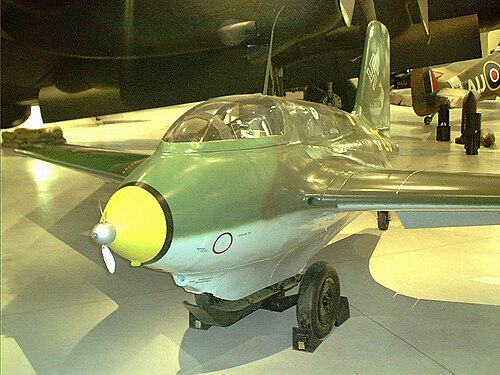
Designed by Alexander Lippisch as a tailless fighter, the Me 163 Komet was the only rocket-powered interceptor to reach combat. It first flew in 1941 at Peenemünde and entered service with Jagdgeschwader 400 in May 1944 to attack Allied bomber formations. Its explosive climb rate and brief powered endurance, only a few minutes, made interception difficult, and handling its corrosive fuels caused more losses to accidents than to enemy action.
Challenge answers
1 / 10
Which aircraft appears in this photograph?
The Messerschmitt Me 163 Komet
The Messerschmitt Me 262 Schwalbe
The Arado Ar 234 Blitz
The Heinkel He 162 Volksjäger
The Me 163 Komet is recognizable by its short, tailless fuselage and swept wings, characteristic of Alexander Lippisch's design.
2 / 10
What role did organizations like the USO and ENSA play during the war?
Bringing music, theatre and film to the troops to keep up their morale
Coordinating the recruitment of new combat troops
Distributing field rations at the battlefronts
Administering military hospitals in the rear
Both the USO and ENSA were dedicated to organizing shows and entertainment activities to lift troop morale.
3 / 10
What was the main reason the Japanese Tokyo Express convoys operated exclusively at night?
Allied air superiority made ships highly vulnerable during daylight
Japanese destroyers lacked night radar
Ocean currents were only favorable at night
A diplomatic order required it
By day, Allied aircraft based at Henderson Field turned Japanese ships into easy targets, so they operated only at night.
4 / 10
The SOMUA S35 stood out from most tanks of its era in how its hull and turret were manufactured. What did that particularity consist of?
They were made from cast sections rather than riveted or bolted armor plates
They were made from armor plates riveted onto an internal frame
They had no turret, with the gun fixed in the hull
They were made from armor plates welded together
The use of casting for hull and turret, instead of traditional riveting, gave the SOMUA S35 a more continuous shape and protection considered advanced for 1940.
5 / 10
Who led the Japanese side, opposite the American admiral Fletcher?
Vice Admiral Takagi
Chūichi Nagumo
Nobutake Kondō
Tamon Yamaguchi
Takagi headed the Japanese carrier force; Fletcher the Allied one.
6 / 10
For what purpose did agents of the German espionage networks based in Argentina transmit information?
to inform Berlin about the movements of Allied ships in the South Atlantic
to coordinate a German military landing in Patagonia
to fund local Argentine political parties
to sabotage Mexican oil production
German agents used radio transmissions to inform Berlin about the movements of Allied ships in the South Atlantic.
7 / 10
What was the second raid on Schweinfurt on 14 October 1943 known as, because of its severe losses?
Black Thursday
Bloody Sunday
The Night of Broken Glass
Black Friday
The raid on 14 October 1943 became known as Black Thursday because of losses even heavier than the August attack.
8 / 10
Which British destroyer, photographed in 1943, flew the flag of the officer commanding the escort during the defence of convoy JW-51B?
HMS Onslow
HMS Sheffield
HMS Achates
HMS Obedient
Captain Sherbrooke directed the defence of convoy JW-51B from the destroyer HMS Onslow, his flagship.
9 / 10
Unlike the organisation into three large formations that carried out the invasion on the ground, what role did Hitler's Directive 21 play?
Set out in writing, months earlier, the politico-military framework that organisation had to fulfil
Completely replace the command of the three formations once the campaign began
Cancel the objectives that were later set on the ground
Be drafted after the invasion began in order to justify it
The document set out months in advance the framework that the three army groups later carried out on the ground.
10 / 10
Who demanded that the new Japanese super-heavy tank be at least twice the size of the Type 95, giving rise to the O-I project?
Colonel Hideo Iwakuro
General Tomoyuki Yamashita
Admiral Isoroku Yamamoto
Engineer Tomio Hara
Colonel Hideo Iwakuro, of the Army Ministry, ordered the development of a tank at least twice the size of the Type 95.
Today's challenge is another ten questions. No sign-up, nothing to install.