These are the ten questions from War Dossier daily challenge #15, of 7 October 2026, with the correct answer and an explanation for each. Today's challenge is a different one and it is free to play.
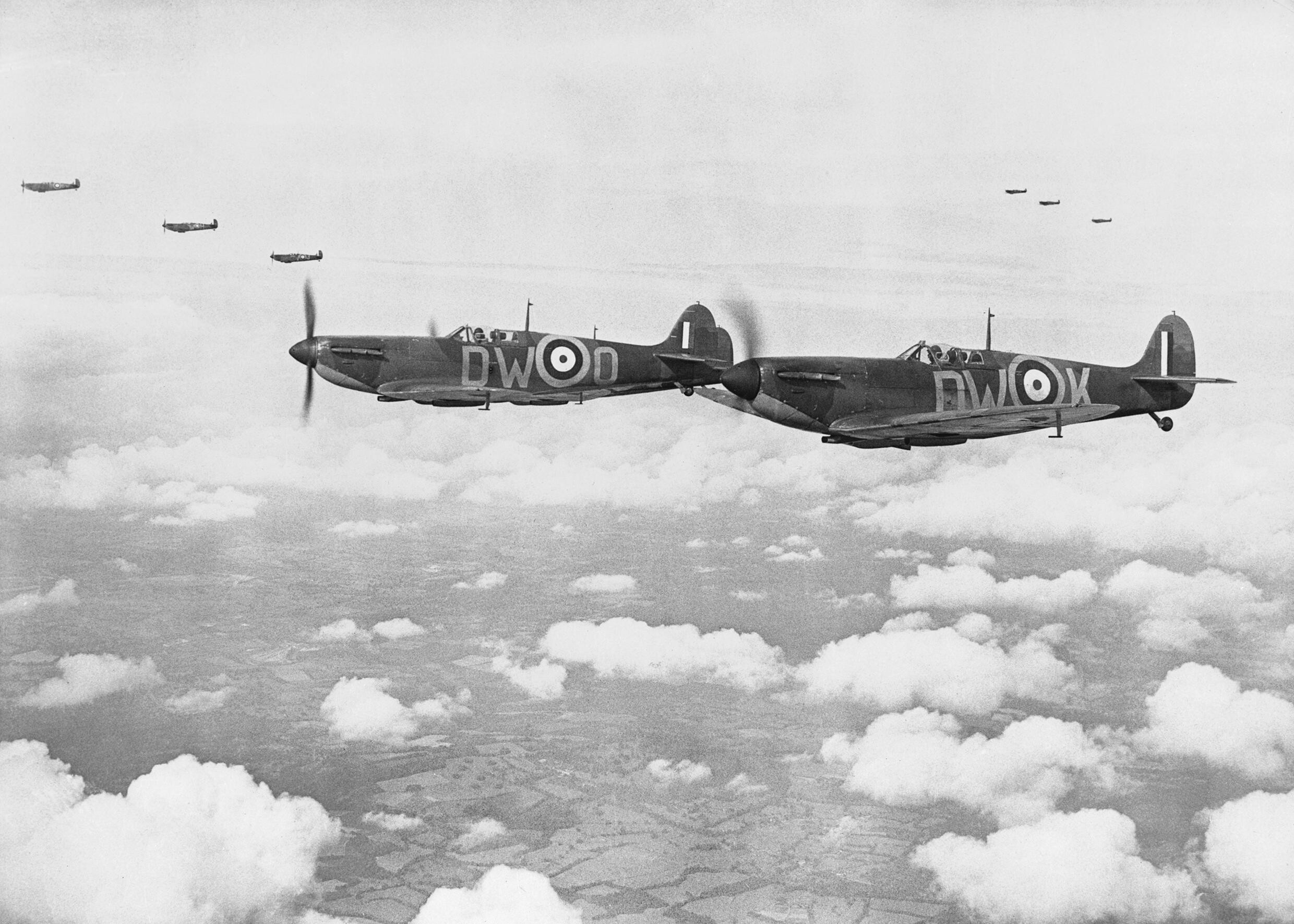
Credit: F/O B J Daventry, Royal Air Force official photographer · Licence: Dominio publico (fotografia anterior a 1957, Crown Copyright, IWM)
Challenge answers
1 / 10
The photograph shows Spitfire fighters flying in a tight three-aircraft formation. What was this formation known as in the RAF?
'Vic' formation
Finger-four
Line astern formation
Echelon formation
The 'vic' formation, with three fighters flying tightly together in a V shape, was the RAF standard at the start of the battle, inherited from 1930s doctrine and designed more for visual order than for scanning the sky.
2 / 10
In what year was the Battle of Medenine, the last German offensive attempt in North Africa, fought?
1943
1942
1944
1941
The battle was fought on 6 March 1943, in the final phase of the Tunisia campaign.
3 / 10
What was the actual (unsloped) thickness of the T14's frontal glacis plate, the Anglo-American assault tank project?
About 50 mm
76 mm
305 mm
About 127 mm
The T14's frontal glacis plate was actually about 50 mm thick, but its steep slope of around 60 degrees raised its effective line-of-sight protection to around 127 mm, similar to a Tiger I.
4 / 10
What was to happen to the French fleet under the terms of the June 1940 Franco-German armistice?
It had to be demobilised in its ports under supervision
It had to be handed over entirely to the Kriegsmarine
It had to sail to British ports
It had to be scuttled immediately at sea
The text provided for demobilisation under German or Italian supervision, without formal transfer of the ships.
5 / 10
Unlike the siege of Odessa, which lasted more than two months, what distinguishes the Battle of Uman in terms of duration?
It was resolved within a few weeks of maneuvering and fighting
It dragged on for more than a year without resolution
It ended within hours of beginning
It was never fully closed
The Uman pocket developed and was resolved within a few weeks, far faster than Odessa's prolonged resistance against the Axis siege.
6 / 10
In what year did construction of the Siegfried Line begin?
1936
1929
1940
1933
The first works began in 1936, with a major reinforcement push known as the 1938 'Limes Program' shortly before the outbreak of war.
7 / 10
How many 5-inch guns did an Essex-class carrier carry as its main surface/anti-aircraft armament?
12
4
24
2
An Essex carried 12 five-inch guns, complemented by dozens of 40mm Bofors and 20mm Oerlikon pieces, forming a layered anti-aircraft defense against Japanese air attacks and kamikazes.
8 / 10
Which branch of the Francs-Tireurs et Partisans (FTP) mainly brought together foreign-born fighters resident in France?
The Immigrant Labour branch
The French Foreign Legion
The Special Organisation (OS)
The Youth Battalions
The Immigrant Labour branch brought together foreign-born fighters resident in France within this organisation.
9 / 10
Comparing the fascine to the Churchill ARK as solutions for crossing a ditch, what is the key difference?
The fascine permanently fills the ditch; the ARK serves as a reusable bridge
Both do exactly the same thing in the same way
The fascine is a whole vehicle and the ARK is just an accessory
The ARK is only used in water and the fascine only on land
The fascine is a one-time bundle that ends up buried in the ditch, filling it; the Churchill ARK, by contrast, is a whole vehicle that positions itself inside the obstacle and deploys ramps, itself becoming the bridge structure that other vehicles drive over, and it can in theory be recovered.
10 / 10
Approximately how many Hetzers were built between March 1944 and May 1945?
About 2,827
About 300
About 15,000
About 50
About 2,827 units were built, making it the Wehrmacht's most numerous light tank destroyer in the war's final months.
Today's challenge is another ten questions. No sign-up, nothing to install.