These are the ten questions from War Dossier daily challenge #9, of 1 October 2026, with the correct answer and an explanation for each. Today's challenge is a different one and it is free to play.
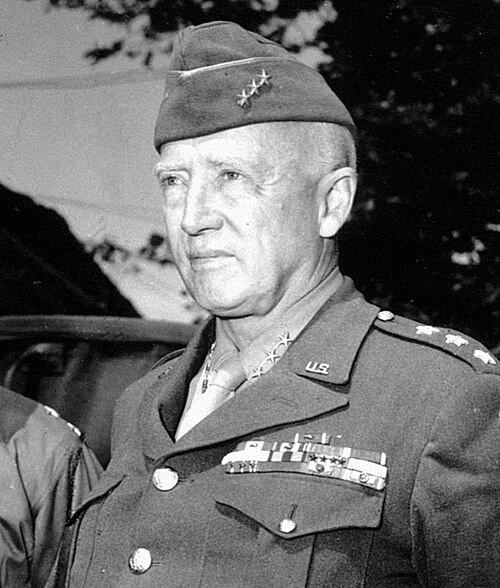
Credit: Autor desconocido, expediente militar de Patton · Licence: Dominio público (obra oficial del Ejército de EE. UU.) · View at original source
The dossier entry: Patton
George S. Patton (1885-1945) was a US Army general known for his aggressive temperament and mastery of armored warfare. He took part in the Allied landings in North Africa (1942) and the Sicily campaign (1943), leading II Corps and the Seventh Army respectively. In 1944 he took command of the Third Army, with which he drove an exceptionally rapid advance across France after the Normandy landings and played a decisive role in relieving Bastogne during the German Ardennes offensive. His aggressive, unconventional command style contrasted with the caution of many of his peers, earning him both admiration and friction with his superiors.
Challenge answers
1 / 10
Which US general, shown here during World War II, was known for his combative temperament and mastery of armored warfare?
George S. Patton
Omar Bradley
Douglas MacArthur
Dwight D. Eisenhower
The image shows George S. Patton, famed for his aggressive command of armored units.
2 / 10
Who first observed, in 1928, the antibacterial effect of the mold from which penicillin comes?
Alexander Fleming
Howard Florey
Ernst Chain
Gerhard Domagk
Fleming noticed in 1928 that a Penicillium mold stopped bacterial growth; Florey and Chain later turned it into a drug.
3 / 10
In what year did the Malinta Tunnel operate as headquarters and hospital during the siege of Corregidor?
1942
1941
1943
1944
The complex operated at full capacity during the siege of Corregidor in 1942.
4 / 10
Among these Axis commanders, who was the only Navy admiral, rather than an Army general, in command of a carrier fleet?
The commander of the First Air Fleet at Pearl Harbor and Midway
The commander of the defense of Iwo Jima
The commander of the defense of Okinawa
The one who was Prime Minister of Japan
Nagumo, a Navy vice admiral, commanded the carrier force at Pearl Harbor and Midway; the other generals in this group commanded ground troops.
5 / 10
What kind of military support did Finland receive from its main ally during the Continuation War?
weapons, supporting troops, and logistical supplies
diplomatic support only
captured Soviet warships
borrowed American aircraft
Germany provided weapons, supporting troops, and logistical supplies to Finland.
6 / 10
What captured Soviet piece did the Romanian TACAM R-2 carry in its open casemate?
The 76.2 mm ZiS-3 gun
The M1938 122 mm howitzer
The F-34 gun from a T-34
The 1937-model 45 mm anti-tank gun
The TACAM R-2 made use of captured Soviet 76.2 mm ZiS-3 field guns, mounted after removing the R-2's original turret.
7 / 10
What constraint limited General Bernard Freyberg's ability to react to German plans known in advance in Crete?
The need not to reveal that he had Ultra intelligence
A total lack of radio communication with his battalions
An order from his superiors not to defend Maleme
The absence of reliable maps of the island
Freyberg knew much of the German plan through Ultra intercepts, but had to act cautiously to avoid compromising that source, which constrained his decisions.
8 / 10
How long did the Battle of Peleliu actually last, compared with what General Rupertus had predicted?
About two and a half months, until late November
Exactly the three days predicted
One week
Almost a year
Fighting stretched from 15 September to 27 November 1944, far beyond the predicted three or four days.
9 / 10
What did the Afrika Korps do to reach Tobruk so quickly by early April 1941?
It advanced rapidly during the offensive known as Operation Sonnenblume
It landed directly on the coast next to the port
It advanced under a truce negotiated with Italy
It went around the desert to the south through Sudan
The Afrika Korps' rapid advance during Operation Sonnenblume brought it to Tobruk within weeks.
10 / 10
What large submarine joined the Free French Naval Forces after being rearmed in 1940?
The Surcouf
The Rubis, captured from Germany
The Casabianca, built in England
The Narval, of British origin
The Surcouf, one of the largest submarines of its time, was among the units rearmed in 1940.
Today's challenge is another ten questions. No sign-up, nothing to install.