WW2 trivia · daily challenge archive

War Dossier › Archive › Challenge #56

Leer este reto en español

Challenge #56

These are the ten questions from War Dossier daily challenge #56, of 17 November 2026, with the correct answer and an explanation for each. Today's challenge is a different one and it is free to play.
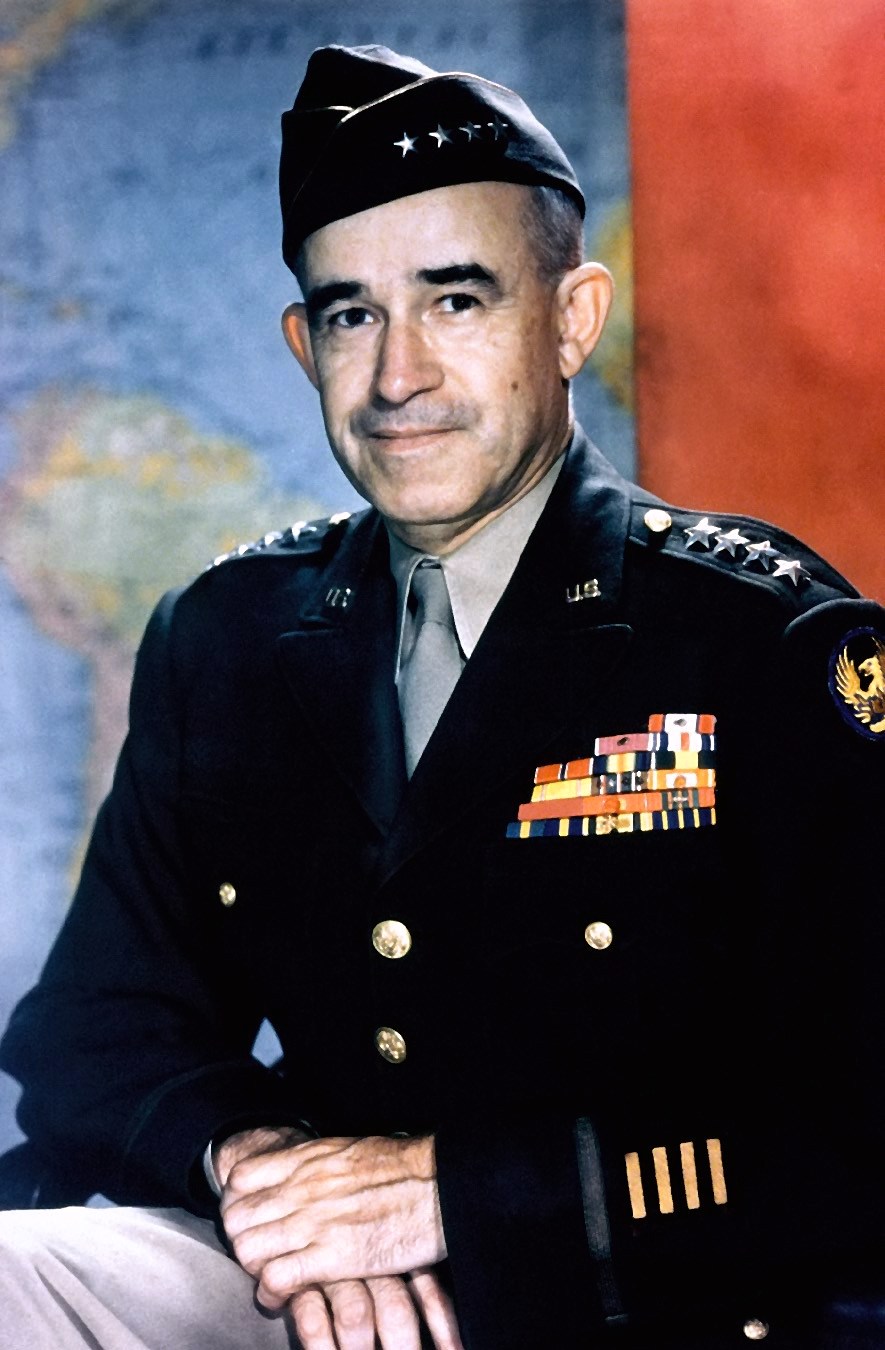
Which American general, shown in this official photograph, arrived in Tunisia in 1943 as Eisenhower's envoy?
Credit: Ejercito de los Estados Unidos · Licence: Dominio publico (obra oficial del Ejercito de EE.UU.) · View at original source

The dossier entry: Omar Bradley, lugarteniente en Túnez

Omar Bradley arrived in Tunisia in early 1943 as Eisenhower's personal envoy to oversee II Corps after Kasserine. At Patton's specific request, he became his deputy commander, while also retaining the authority to represent Eisenhower to the corps. In April 1943 he succeeded Patton in command of II Corps and led it through the final operations of the campaign, including the capture of Bizerte on 7 May 1943.

Challenge answers

1 / 10

Which American general, shown in this official photograph, arrived in Tunisia in 1943 as Eisenhower's envoy?

  • Omar Bradley
  • George Patton
  • Lloyd Fredendall
  • Harold Alexander

The official photograph shows Omar Bradley.

2 / 10

In what year did the Type 100 submachine gun enter service?

  • 1942
  • 1936
  • 1938
  • 1945

The Type 100 entered service in 1942, relatively late compared to other powers' submachine guns, reflecting the low priority Japanese doctrine placed on this weapon type.

3 / 10

In general terms, which side managed to sustain the greater total volume of tank production throughout the war?

  • The Soviet Union and the United States combined
  • Germany
  • Italy and Japan combined
  • Neither; production was equivalent

Combined Soviet and American production clearly exceeded German output in total volume.

4 / 10

What strategy did the United Kingdom use to try to keep Turkish ore from reaching Germany?

  • Preemptive purchases to corner the production
  • A naval blockade of the Bosphorus
  • Bombing the Turkish mines
  • Sabotage of Turkish railways

The British resorted to preemptive buying of the ore to deny Germany the market.

5 / 10

The M7 Priest mounted essentially the same 105 mm howitzer as the M101, but self-propelled. What main advantage did this give it over the towed M101?

  • It could reposition much faster, without a towing vehicle
  • It had much thicker armour than a combat tank
  • It had double the maximum range
  • It could operate underwater

Being mounted on a self-propelled chassis, the M7 could keep pace with armoured columns and shift firing positions quickly, something the towed M101 could not do without a separate tractor or truck.

6 / 10

How many days after the public announcement of the Italian armistice did the landing at Salerno (Operation Avalanche) take place?

  • One day
  • One week
  • One month
  • The same day

The armistice was announced on 8 September and the landing began on 9 September 1943.

7 / 10

What consequence did the arrival of the harsh 1941 winter have on the development of Operation Typhoon?

  • It helped stall the final push of the German offensive on Moscow
  • It sped up the German advance by hardening the muddy ground
  • It forced the Soviet retreat of the capital to Kuibyshev
  • It caused the total suspension of air operations by both sides

The extreme cold, added to previous attrition, helped stall the final German push toward Moscow.

8 / 10

Before 1937, Imperial Japanese Army doctrine assigned tanks a mainly subordinate role. What was that priority function?

  • Direct support for infantry advances, rather than acting as an independent arm
  • Deep armored penetration into the enemy rear, in the style of German Blitzkrieg
  • Long-range independent strategic reconnaissance
  • Fixed coastal defense against amphibious landings

Well into the war, the Imperial Japanese Army treated tanks as infantry support, delaying the development of an independent armored doctrine comparable to other powers.

9 / 10

What was the Japanese field the Americans turned into Isley Field called?

  • Aslito
  • Orote
  • Ushi
  • Kagman

The former Japanese Aslito airfield was renamed Isley Field.

10 / 10

What sentiment recurs in kamikaze pilots' farewell letters alongside duty toward the country, according to historians' analysis?

  • deep affection for family
  • resentment toward commanders
  • the desire to desert
  • total indifference toward death

Historians note that these letters combine patriotic duty with deep family affection, far from the fanatical stereotype.

Today's challenge is another ten questions. No sign-up, nothing to install.

Play today's challenge