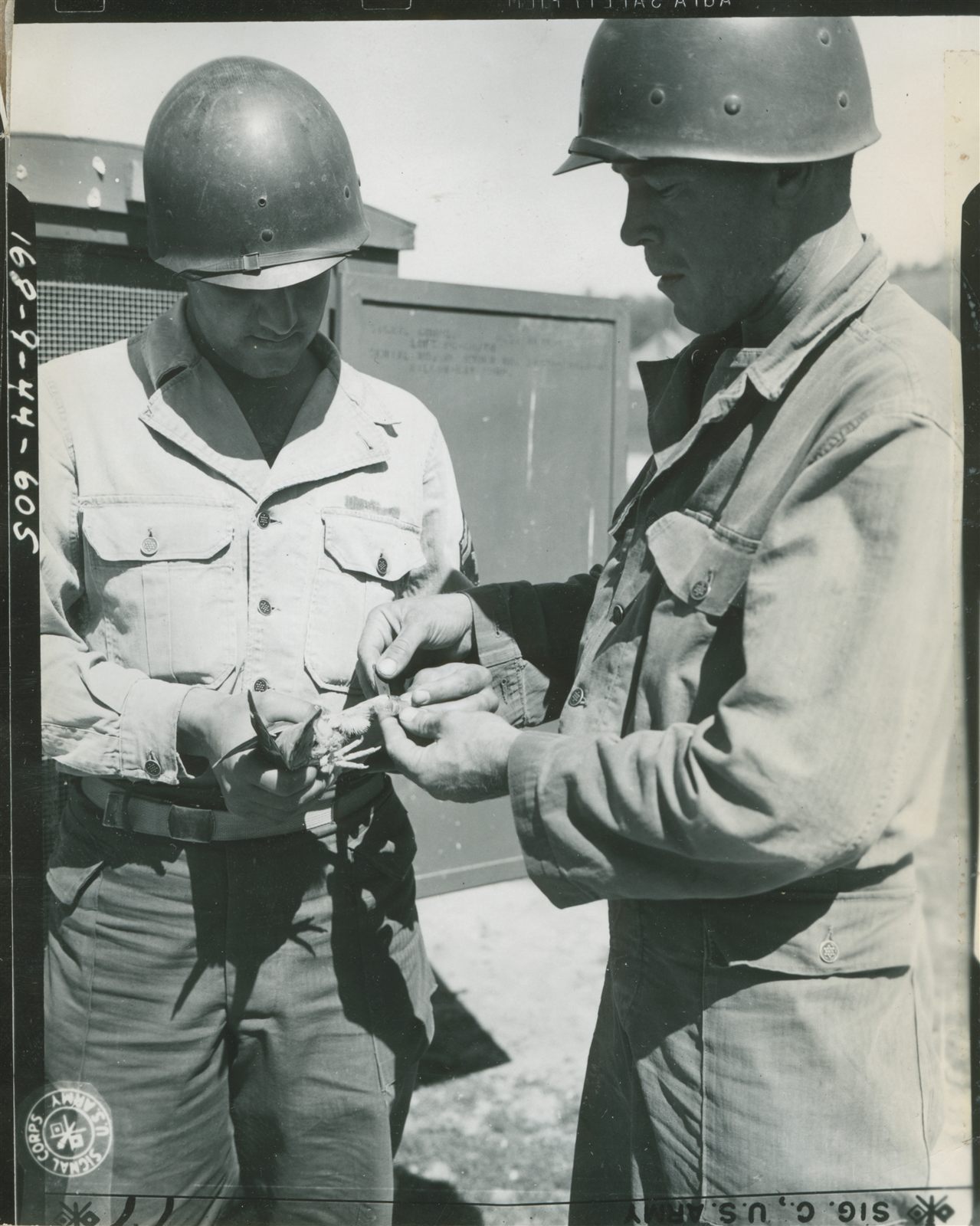
These are the ten questions from War Dossier daily challenge #52, of 13 November 2026, with the correct answer and an explanation for each. Today's challenge is a different one and it is free to play.
Credit: US Army Signal Corps (fotógrafo: Freeney) · Licence: Dominio público (PD-USGov, US Army Signal Corps) · View at original source
Challenge answers
1 / 10
What are these US Army Signal Corps soldiers doing in this photograph?
Attaching a message capsule to a homing pigeon's leg
Repairing a field radio
Loading ammunition into a rifle
Developing reconnaissance photographs
The photo shows two soldiers holding a homing pigeon while attaching a small message capsule to its leg, a routine procedure of the US Army Pigeon Service during World War II.
2 / 10
What was a Rhino ferry mainly built from?
Standard steel pontoons bolted together
Plywood hulls
Inflatable rubber tires
Precast concrete beams
Each Rhino ferry was built by joining about 180 standard steel pontoons (roughly 5x7x5-foot blocks) into a platform about 150 feet long by 42 feet wide.
3 / 10
Which other episode contrasts most clearly with the failed Dakar landing, both occurring in 1940 with opposite outcomes?
The rallying of French Equatorial Africa
The Franco-German armistice
The Japanese occupation of French Indochina
The British attack on the French fleet at Mers-el-Kébir
Both took place in 1940, but while French Equatorial Africa's rallying succeeded, this attempt failed.
4 / 10
Who commanded the Brazilian Expeditionary Force in Italy?
General João Baptista Mascarenhas de Moraes
Marshal Eurico Gaspar Dutra
General Zenóbio da Costa
General Cordeiro de Farias
Mascarenhas de Moraes commanded the Brazilian expeditionary division throughout the Italian campaign.
5 / 10
Which British ship collided with the heavy cruiser Admiral Hipper during the Norway operation, damaging her armour?
The destroyer HMS Glowworm
The cruiser HMS Exeter
The battleship HMS Warspite
The destroyer HMS Cossack
The destroyer HMS Glowworm rammed the cruiser before being sunk, damaging her armour belt and a torpedo launcher.
6 / 10
Unlike the pact signed in Moscow weeks earlier, this late-September partition was no longer a theoretical agreement but the practical application of a line drawn over:
Polish territory already occupied by both armies
French territory
Romanian territory
Czech territory
By late September both armies already occupied Poland, so the new treaty formalised a situation that already existed on the ground.
7 / 10
Which German field marshal surrendered to Rokossovsky's forces at Stalingrad?
Friedrich Paulus
Erich von Manstein
Fedor von Bock
Walther von Reichenau
Commanding the Don Front, Rokossovsky accepted Field Marshal Friedrich Paulus's surrender in February 1943.
8 / 10
In practice, what happened if a correspondent repeatedly broke the rules of military censorship?
He lost his accreditation and was sent home
He received an honorary promotion from Allied command
He went on to work directly for the government
He was assigned his own combat unit
Anyone who broke the censorship pledge risked having his accreditation revoked and being sent home.
9 / 10
Why was the 88 mm deck gun removed from many Type VII U-boats from 1943 onward?
Because of Allied anti-submarine air threat: fast diving and anti-aircraft weapons
Because the entire fleet ran out of 88 mm ammunition
Because the gun turned out to be incompatible with the torpedoes
Because an international treaty banned deck guns on submarines
From 1943, radar-equipped Allied patrol aircraft made staying on the surface to use the gun very dangerous; priority shifted to stronger anti-aircraft weapons and faster diving ability.
10 / 10
The Ki-61 Hien was the only mass-produced Japanese fighter with a liquid-cooled inverted-V engine. Which other aircraft in this collection, a heavy American fighter, also used a liquid-cooled engine instead of a radial one?
The P-38 Lightning, with Allison V-1710 engines
The F6F Hellcat, with a Pratt & Whitney R-2800 engine
The SBD Dauntless, with a Wright R-1820 engine
The B-29 Superfortress, with Wright R-3350 engines
The P-38 Lightning used two liquid-cooled Allison V-1710 engines, unlike most fighters in this collection which used air-cooled radial engines, such as the Hellcat, the Dauntless, or the B-29 itself.
Today's challenge is another ten questions. No sign-up, nothing to install.