These are the ten questions from War Dossier daily challenge #48, of 9 November 2026, with the correct answer and an explanation for each. Today's challenge is a different one and it is free to play.
Credit: Fotografo oficial de la RAF (Imperial War Museums) · Licence: Dominio publico · View at original source
The dossier entry: Bases aéreas de las Azores
In October 1943, Portugal authorized Britain to establish air and naval bases in the Azores archipelago, invoking the centuries-old Anglo-Portuguese alliance. The move, known to the Allies as Operation Alacrity, helped close the mid-Atlantic 'black hole' where German submarines had operated beyond the reach of Allied aircraft, strengthening convoy protection. Months later, the United States also obtained similar facilities in the islands.
Challenge answers
1 / 10
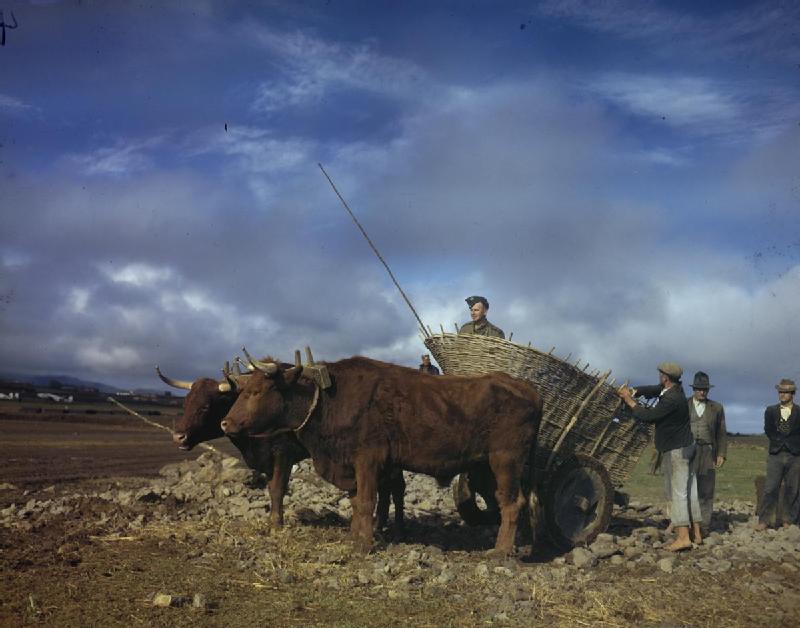
In which Atlantic archipelago, where Portugal authorized Allied bases in 1943, was this photograph of an airfield taken?
The Azores
The Falkland Islands
The Canary Islands
Bermuda
The image, from January 1944, shows an Allied airfield in the Azores, where Portugal granted the use of bases in 1943.
2 / 10
Which admiral recommended cancelling the invasion of Peleliu two days before the landing?
William Halsey
Chester Nimitz
Raymond Spruance
Douglas MacArthur
Admiral William Halsey sent an urgent message proposing to cancel the operation, two days before the scheduled landing date.
3 / 10
Who signed the German surrender before Soviet Marshal Georgy Zhukov at Karlshorst?
Field Marshal Wilhelm Keitel
Adolf Hitler in person
Field Marshal Ferdinand Schörner
Hermann Göring
Field Marshal Wilhelm Keitel signed the instrument of surrender before Zhukov in Berlin-Karlshorst.
4 / 10
Why was the loss of aviators so serious for Japan?
It could not train veteran pilots fast enough to replace them
Because they were hired foreign pilots
Because Japanese high command halted production of new combat aircraft
Because the pilots had deserted en masse
Training experienced aviators took a long time, impossible to make up in the middle of the war.
5 / 10
Unlike the swift advance expected, the Third Army at Metz endured…
A prolonged siege of nearly three months
An encirclement settled in a few days
An airborne assault
An immediate river crossing
The forts of Metz held Patton up for nearly three months.
6 / 10
In what month and year did the first convoy to travel the complete road arrive in Kunming?
February 1945
December 1942
August 1944
May 1943
The convoy left Ledo on 12 January 1945 and arrived in Kunming on 4 February 1945.
7 / 10
What effect did Governor Félix Éboué's decision to rally to Free France have on the rest of French Equatorial Africa's territories?
Other territories in the region rallied in the following weeks
It caused a definitive break with London
It led to the region's annexation by Vichy
It had no effect on neighbouring territories
His example encouraged other territories in the region to declare for Free France shortly after.
8 / 10
Why could several different crews, each separately, claim to have destroyed the same enemy tank after a single engagement?
Because each hit the target with a shot without knowing others had too, and all reported it as their own
Because command deliberately ordered two crews to always fire at the same target
Because intelligence services spread falsified loss reports to confuse the enemy
Because each regiment had to report a fixed quota of destroyed targets, invented if necessary
In the chaos of battle, several crews could hit the same target without knowing it and each claim it as their own.
9 / 10
Besides the executions on land, what other circumstance raised the death toll among the prisoners of the Acqui Division in Cephalonia?
The sinking of ships transporting prisoners
A typhus outbreak in the barracks
An Allied bombing by mistake
A failed mass escape
Several ships evacuating prisoners toward the mainland sank, costing more than a thousand additional lives.
10 / 10
Which Zrínyi variant, armed with a long 75 mm anti-tank gun, never got past the prototype stage?
The Zrínyi I
The Zrínyi III
The Turán III
The Toldi III
The Zrínyi I, envisioned as a tank destroyer with a long 75 mm gun, only reached a single prototype (completed in 1944) and never entered series production, mainly due to manufacturing problems with that gun; the 105 mm howitzer-armed Zrínyi II, by contrast, was produced in numbers.
Today's challenge is another ten questions. No sign-up, nothing to install.