These are the ten questions from War Dossier daily challenge #37, of 29 October 2026, with the correct answer and an explanation for each. Today's challenge is a different one and it is free to play.
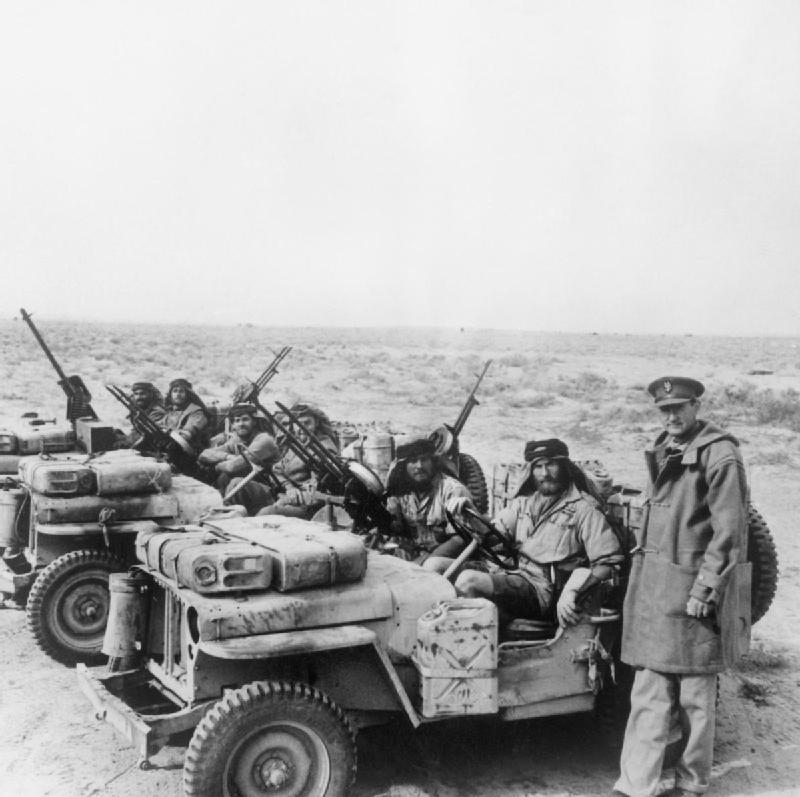
Credit: No. 1 Army Film and Photographic Unit - Capt. G. Keating · Licence: Dominio público (obra del Gobierno del Reino Unido, IWM) · View at original source
The dossier entry: El SAS y David Stirling
The Special Air Service (SAS) was founded in North Africa in 1941 by Scottish officer David Stirling, aiming to form small teams able to infiltrate behind enemy lines to sabotage Axis airfields and supply depots. Initially known as L Detachment, SAS Brigade, the unit grew into one of the most influential special forces of the Second World War.
Challenge answers
1 / 10
The photograph shows an officer beside a motorised patrol in the North African desert in 1943. Which unit did they belong to?
The Special Air Service (SAS)
The Long Range Desert Group
Popski's Private Army
The British Commandos
The image shows David Stirling with an SAS jeep patrol returning from a desert operation in January 1943.
2 / 10
As part of which larger naval operation did the sinking of the USS St. Lo take place?
the battle off Samar, within Leyte
the Battle of the Philippine Sea
the Okinawa campaign
the Battle of the Coral Sea
The attack occurred on 25 October 1944, during the battle off Samar, part of the Battle of Leyte Gulf.
3 / 10
What tasks did the dogs trained by the American program recruiting civilian pets perform?
Guard duty, messaging and scouting on the front
Driving light reconnaissance vehicles
Repairing field telephone lines
Cooking and supply duties in camps
These dogs were trained for sentry, messenger and scouting duties on various fronts.
4 / 10
What effect did British air attacks have on the barge fleet assembled for Operation Sea Lion while it remained concentrated in the ports?
They sank and damaged a significant number of barges
They caused no significant damage according to German reports
They forced the entire fleet to be moved to the Baltic Sea
They caused the total sinking of the fleet before the postponement
RAF bombing raids on the assembly ports sank and damaged a considerable number of barges while they awaited the order to sail.
5 / 10
How many Type XXI boats completed a war patrol before the war ended?
Only one
The entire fleet built
None, all remained in port
About twenty
Of 118 boats commissioned, only one put to sea on patrol, in the war's final weeks.
6 / 10
What combination of wing and nose weapons did the Ki-61 Hien carry?
2 Ho-5 cannons of 20 mm and 2 Ho-103 machine guns of 12.7 mm
4 Type 99 cannons of 20 mm only
2 Ho-103 machine guns of 12.7 mm only
6 .50 cal machine guns
The Ki-61 combined 2 Ho-5 cannons of 20 mm with 2 Ho-103 machine guns of 12.7 mm, a heavier armament than the Ki-43 Hayabusa's and well suited to tackling well-armored Allied bombers.
7 / 10
Unlike the Panzer 38(t), which kept its 37 mm gun throughout its career, what did the Panzer III do differently with its armament?
It was changed several times for larger calibres
It never changed guns
It removed the main gun in its final versions
It adopted a flamethrower in its final version
The Panzer III went through at least three different guns of increasing calibre, while the Panzer 38(t) kept its original 37 mm gun.
8 / 10
What navigation principle did the GEE system use?
Hyperbolic navigation via time-difference-of-arrival
Optical triangulation using stars
Inertial guidance via gyroscopes
Retransmission of enemy beacon signals
GEE was the first operationally used hyperbolic navigation system: it measured the time difference between pulses from a master station and several secondaries to plot hyperbolic curves whose intersection gave the position.
9 / 10
What visually distinguishes the Fw 190 from its squadron-mate, the Bf 109?
A short, rounded nose with a radial engine, instead of the Bf 109's long, narrow nose
A twin fuselage, similar to the American P-38 Lightning, instead of the Bf 109's single fuselage
An inverted gull wing, like the Vought F4U Corsair, instead of the Bf 109's straight wing
Fixed, spatted landing gear, like the Junkers Ju 87's, instead of the Bf 109's retractable gear
Its short, rounded nose with a radial engine and a large-diameter propeller clearly sets it apart from the Bf 109's long, narrow nose. It could carry up to 500 kg of bombs on strike missions.
10 / 10
Which rifle is shown in the photograph?
Arisaka Type 99
Mosin-Nagant M91/30
Kar98k
M1 Carbine
You can spot it by the sliding metal dust cover over the bolt, a feature unique among the rifles on this list. It was the standard infantry rifle of the Imperial Japanese Army.
Today's challenge is another ten questions. No sign-up, nothing to install.