These are the ten questions from War Dossier daily challenge #28, of 20 October 2026, with the correct answer and an explanation for each. Today's challenge is a different one and it is free to play.
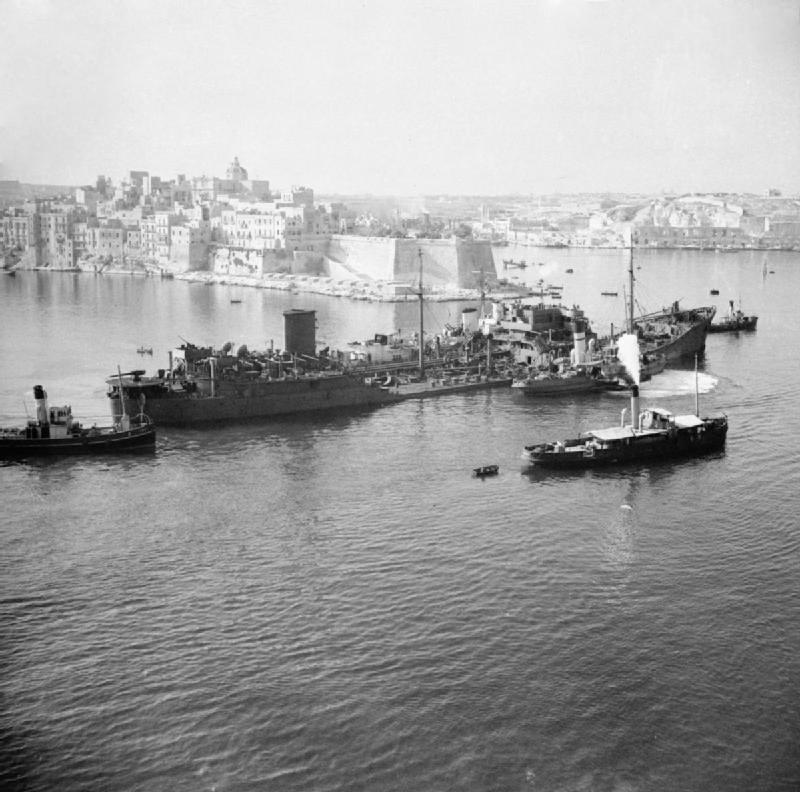
Credit: H. E. Cook (teniente, fotografo oficial del War Office) · Licence: Dominio publico (Crown Copyright, Reino Unido) · View at original source
The dossier entry: El petrolero SS Ohio
The SS Ohio was an oil tanker built in the United States in 1940, transferred to British registry to serve as the key vessel of the Operation Pedestal convoy: without her cargo of fuel, Malta could not have kept its fighters flying or its submarines at sea. Struck by bombs, torpedoes and even a shot-down Axis aircraft that crashed onto her deck, she was left half-sunk and without power of her own, yet was towed by Royal Navy destroyers into Valletta's Grand Harbour on 15 August 1942. Her master, Dudley Mason, was awarded the George Cross for the feat.
Challenge answers
1 / 10
Which tanker, being towed by small vessels, is shown entering Valletta's Grand Harbour in this August 1942 photograph?
The SS Ohio
The SS Melbourne Star
HMS Eagle
The SS Waimarama
The image documents the Ohio's final arrival at Malta on 15 August 1942, towed in after suffering extremely severe damage.
2 / 10
Which international convention was supposed, at least in theory, to govern the treatment of Allied prisoners of war in Germany?
The 1929 Geneva Convention
The 1907 Hague Convention
The 1941 Atlantic Charter
The 1919 Treaty of Versailles
Germany had signed the 1929 Geneva Convention on prisoners of war, which set minimum standards for housing, food and mail, though compliance varied depending on the captive's nationality.
3 / 10
What weapon was the T-43's enlarged turret adapted to mount after the project's cancellation, giving rise to a new tank?
An 85mm gun, giving rise to the T-34-85
A 100mm gun, giving rise to the T-44-100
A 122mm gun, giving rise to the IS-2
A flamethrower, giving rise to the OT-34
The T-43's enlarged turret was adapted to mount an 85mm gun on the T-34 hull, creating the T-34-85.
4 / 10
What was the burst rate of fire of the 'French 75'?
Between 15 and 30 rounds per minute
Between 1 and 2 rounds per minute
More than 100 rounds per minute
Between 5 and 8 rounds per minute
In a short burst it could fire between 15 and 30 rounds per minute, an extraordinary rate for early 20th-century field artillery thanks to its recoil system.
5 / 10
What feature set Fougasse's posters apart from others on the same theme?
Humour and a comic tone
The use of real photographs
Texts in several languages
The total absence of drawings
Fougasse relied on graphic humour, unusual for security campaigns.
6 / 10
The proclamation of the Salo Republic took place almost at the same time as the formation of another, opposing organisation. Which one?
The National Liberation Committee, which united the antifascist parties
The National Republican Army
The Acqui Division in Cephalonia
The partisan group that captured Mussolini in 1945
Both emerged in September 1943, on opposite sides of Italy's new political divide.
7 / 10
What highly significant act took place in Baguio after the end of the war?
The formal signing of the Japanese surrender in the Philippines, on 3 September 1945
The signing of the armistice with the United States, in August 1945
The proclamation of Philippine independence
The handover of Corregidor to Philippine authorities
In this city, General Yamashita signed the formal surrender of Japanese forces in the Philippines on 3 September 1945.
8 / 10
What did Sergeant John Basilone do when most of his machine-gun section was put out of action?
He personally resupplied and operated the machine guns under enemy fire
He ordered an immediate withdrawal of the entire line
He requested his unit be relieved before dawn
He left his position to seek reinforcements in the rear
When most of his men fell or their guns jammed, he personally kept the machine guns firing and carried ammunition forward under enemy fire.
9 / 10
What decision, taken a few days later, reinforced Hitler's personal control over compliance with this stand-fast order?
Hitler personally taking direct command of the Army
The signing of a local armistice
The relocation of headquarters to Smolensk
The creation of a new front in the south
On 19 December 1941 Hitler took command of the OKH, concentrating direct oversight of orders like this one in his hands.
10 / 10
What real limitation affected the effectiveness of Fortress Singapore's guns during the battle?
Most of their shells were armour-piercing rounds meant for ships
Most of their guns were fixed seaward, with little traverse towards land
They had been dismantled and shipped to Egypt before the battle
They could only fire at night
Armour-piercing ammunition, designed against naval armour, had little effect against troops ashore.
Today's challenge is another ten questions. No sign-up, nothing to install.